
Market Cap Is Rising. Governance Still Has to Catch Up.
Market Cap Is Rising. Governance Still Has to Catch Up.
Daily Setup / Perspective
Bitcoin treasury companies are having another moment.
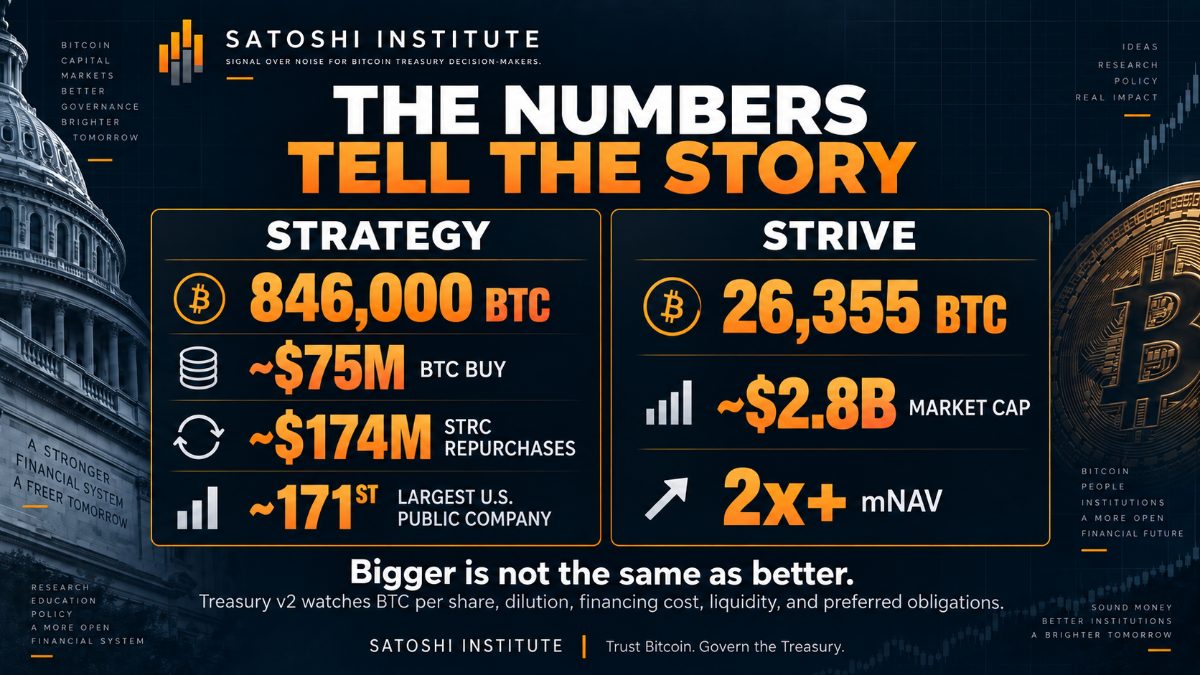
Strategy reportedly passed FedEx in market capitalization, moving to roughly the 171st-largest U.S. public company. Strive has been moving rapidly up the rankings as well, with its market capitalization recently surpassing Shake Shack and its shares dramatically outperforming Bitcoin year to date.
Those are impressive milestones.
They are also exactly the kind of milestones that can distract investors from the more important question: What produced the value?
A higher market capitalization is not, by itself, evidence of a better treasury.
It may reflect:
- Bitcoin appreciation,
- mNAV expansion,
- new capital issuance,
- preferred financing,
- leverage,
- improved BTC per share,
- or simply investors becoming willing to pay more for the wrapper.
Treasury v2 asks us to separate those things.
Because getting bigger is not the same thing as getting better.
The Day’s Signals
1. Strategy is now larger than FedEx
Strategy reportedly moved past FedEx in market capitalization, placing it around the: 171st-largest U.S. public company.
That is a remarkable institutional milestone for a company whose identity has become inseparable from Bitcoin. But the number needs context.
Strategy also recently deployed roughly $75 million into additional Bitcoin while spending approximately $174 million repurchasing STRC preferred shares.
That is the more revealing story.
Strategy is no longer simply converting every available dollar into Bitcoin. It is managing a capital structure around an enormous Bitcoin position.
2. Strive is becoming the treasury market's momentum story
Strive's rapid rise is attracting increasing attention.
Recent discussion puts its market capitalization around $2.8 billion after a strong move in its common stock, while the company now holds 26,355 BTC.
Management has also highlighted substantial equity outperformance relative to Bitcoin. That is naturally attracting comparisons with Strategy. Some are already calling Strive the next version of the Strategy playbook.
That comparison is premature.
The more interesting question is whether Strive can continue improving shareholder economics as the capital structure grows more complex.
3. mNAV is moving from valuation statistic to operating mechanism
The mNAV debate keeps getting louder.
Strive has recently been discussed around an mNAV above 2x, while Strategy trades at a materially different premium. That matters because for treasury companies, mNAV is not merely something investors observe. It can influence what management can do.
A high premium can make common-equity issuance economically attractive.
New equity can finance more Bitcoin.
More Bitcoin can improve BTC per share if the acquisition economics beat the dilution.
That can reinforce the premium.
The celebrated flywheel returns.
But flywheels work in both directions.
4. Management compensation is becoming part of the treasury equation
A more sophisticated discussion is emerging around compensation at Bitcoin treasury companies. That is overdue.
- Management incentives should not merely reward:
- absolute Bitcoin holdings,
- stock-price increases,
- or capital raised.
Those metrics can all rise while shareholder economics deteriorate.
A better framework would consider:
- BTC per diluted share,
- relative performance versus Bitcoin,
- cost of capital,
- risk-adjusted returns,
- and dilution.
5. Smaller treasury companies now face a scale problem
The increasing market capitalization of Strategy and Strive creates another question for the sector.
What happens to the dozens of smaller Bitcoin treasury companies? Some hold hundreds of BTC. Some hold dozens. Many lack the trading liquidity, financing access or brand recognition of the largest players. The market may eventually decide that it does not need dozens of lightly differentiated wrappers around the same asset.
That could create pressure for:
- consolidation,
- mergers,
- capital returns,
- treasury sales,
- or strategic repositioning.
What This Actually Means
The Bitcoin treasury market is beginning to separate scale from quality. Strategy passing FedEx is important. Strive passing hundreds of public companies in market capitalization is important. But neither tells us whether those companies have created the most durable treasury system.
Market capitalization tells us what investors are willing to pay today. Treasury v2 asks what supports that value tomorrow. That means looking beneath the ranking.
How much Bitcoin was added?
How much capital was issued?
What happened to the share count?
What happened to BTC per share?
What obligations were created?
What did the financing cost?
How dependent is the company on mNAV remaining elevated?
Those questions become more important as the companies become larger, not less important. The treasury sector spent its first phase proving that corporations could accumulate Bitcoin at scale. The next phase will determine whether those companies can govern the financial structures they built around it.