
The Wrapper Is Losing Its Premium
The Wrapper Is Losing Its Premium
Daily Setup / Perspective
The Bitcoin treasury trade is entering its least forgiving phase.
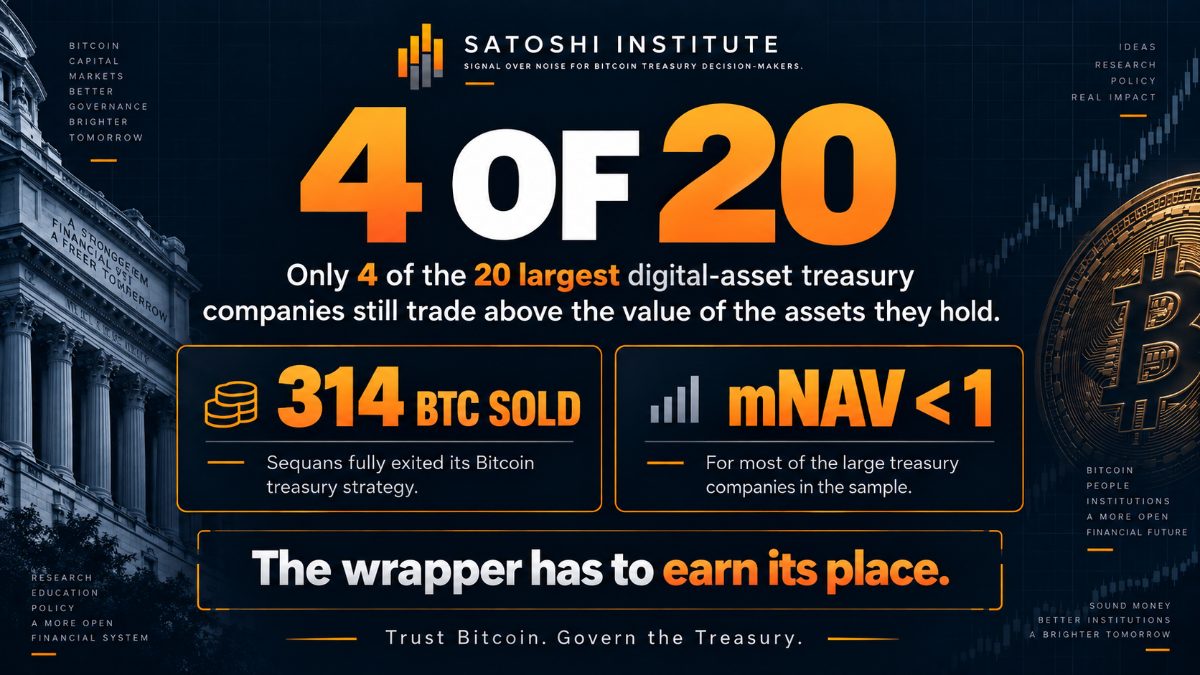
A new DWF Ventures analysis says only 4 of the 20 largest digital-asset treasury companies still trade above the value of their underlying holdings. Most of the rest are below an mNAV of 1. crypto.news
That matters because the premium was never just a valuation curiosity. For many treasury companies, it was the financing mechanism.
Trade above NAV.
Issue equity.
Buy more Bitcoin.
Increase BTC per share.
Repeat.
When the premium disappears, the arithmetic changes.
And some companies are no longer trying to repair the flywheel. They are simply leaving.
The Day’s Signals
1. Only 4 of the top 20 still trade above asset value
DWF Ventures found that only: 4 of the 20 largest digital-asset treasury companies were trading above the value of their underlying crypto holdings as of its recent analysis. crypto.news
That is a striking reversal from the early treasury boom.
The original model relied heavily on the market assigning a premium to the corporate wrapper. That premium allowed companies to issue equity at favorable levels, purchase more Bitcoin, and potentially improve BTC per share without destroying existing shareholder economics.
Below mNAV 1, that becomes much harder.
2. Sequans sells its final 314 BTC
Sequans Communications sold its remaining: 314 BTC and has now fully exited its Bitcoin treasury strategy. The company once held more than 3,200 BTC at its peak. TradingView
Earlier sales had already been used to reduce convertible debt.
Now the experiment is over.
That is important because Sequans was not forced to remain a Bitcoin treasury company forever. It made a different capital-allocation decision.
3. The strongest wrappers are beginning to separate from the rest
The DWF analysis also reinforces something the market has been signaling for months. Not all treasury companies are equal. The firms still commanding premiums tend to have some combination of:
- better capital access,
- stronger operating businesses,
- more differentiated financing,
- greater liquidity,
- or a more credible path to increasing crypto holdings per share. crypto.news
That is a much healthier way to evaluate the sector. Bitcoin ownership alone is not a moat.
4. Credit and preferred capital are becoming the next battleground
As common-equity premiums compress, attention is shifting toward:
- preferred stock,
- convertible debt,
- digital credit,
- and other structured financing.
That makes sense.
A company trading below NAV cannot rely indefinitely on common-share issuance without risking severe dilution. Preferred securities can provide another path. But they also create:
- dividend obligations,
- seniority,
- liquidity requirements,
- and new claims against the same treasury.
5. The macro environment is making the wrapper test harder
Bitcoin has also been dealing with a materially tougher rate environment. The U.S. 10-year Treasury yield has recently moved above 5%, increasing the hurdle rate for risk assets and making alternative sources of yield more competitive. Financial Times
That matters to treasury companies because their financing model competes directly with other capital-market opportunities.
When risk-free rates rise, investors demand more compensation for complexity.
What This Actually Means
The Bitcoin treasury market is moving from expansion to selection.
That is the real story.
The first phase rewarded almost any company that could:
- raise money,
- buy Bitcoin,
- and convince investors to pay a premium for the wrapper.
The second phase is asking something much harder: What happens when the premium disappears?
Sequans provides one answer. Exit. Other companies will choose different paths.
Some will:
- reduce leverage,
- buy back shares,
- issue preferred securities,
- preserve cash,
- merge,
- consolidate,
- or rely on operating cash flow instead of repeated equity issuance.
The important point is that the wrapper is no longer getting a free pass.
Investors are increasingly demanding evidence that the company adds economic value beyond simply holding Bitcoin. That is Treasury v2.