
The Treasury Trade Is Moving From Coins to Capital Architecture
The Treasury Trade Is Moving From Coins to Capital Architecture
Daily Setup / Perspective
The Bitcoin treasury conversation is changing.
For the first phase, the market mostly asked one question: Who bought more Bitcoin?
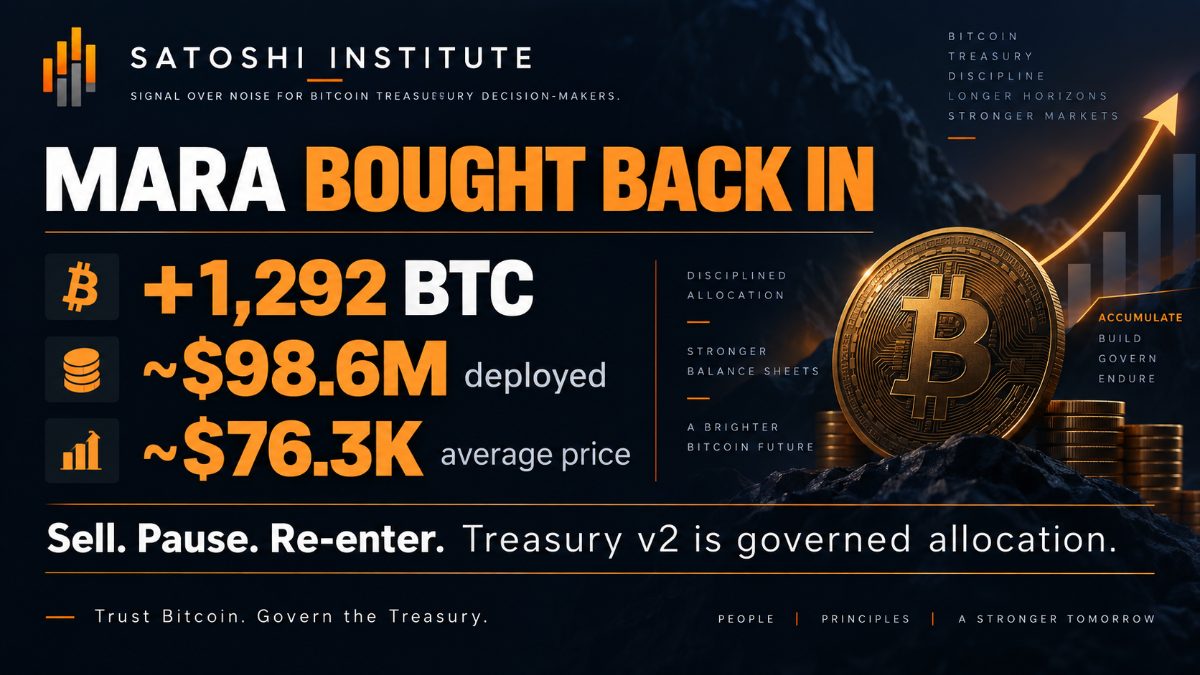
That question still matters. Strive has now reached exactly 25,000 BTC after adding another 469 BTC for roughly $36.6 million. MARA reportedly added another 1,292 BTC for about $98.6 million. Corporate accumulation has not stopped simply because Bitcoin has been trading under pressure in the mid-$70,000s. Pasted text.txtTXT
But the more interesting development is happening one level beneath the Bitcoin.
Companies are increasingly competing over how the Bitcoin gets financed.
- Preferred stock.
- Operating cash flow.
- Warrants.
- Debt.
- ETF packaging.
And, increasingly, the ability to manage those structures after they have been created.
The Bitcoin balance is still visible.
The financing architecture is becoming the strategy.
The Day’s Signals
MARA Sold 20,880 BTC. Now It Is Buying Again.
That gives us a much stronger Treasury v2 thesis:
A governed Bitcoin treasury is not defined by permanent accumulation. It is defined by the ability to change capital allocation as corporate priorities change.
MARA sold heavily to fund liquidity and AI/HPC expansion, then returned to the market with a $98.6M Bitcoin purchase. Stack BTC is trying to acquire operating cash flow to support future accumulation. Meanwhile, Bitcoin itself is sitting near $75K with 10-year yields near 5%.
That is today’s story.
Not “who bought more?”
What changed in the capital-allocation equation, and why?
What This Actually Means
The Bitcoin treasury model is becoming less ideological and more corporate. That is a good thing.
MARA reportedly sold roughly 20,880 BTC earlier in 2026 to fund liquidity, operations and AI/HPC expansion. Now it has returned to the market and purchased another 1,292 BTC for about $98.6 million. The important point is not that MARA sold. And it is not that MARA bought again.
The important point is that Bitcoin was treated as one competing use of capital among several.
That is how mature treasury management works.
Capital can move toward:
- Bitcoin,
- cash,
- debt reduction,
- operations,
- AI/HPC infrastructure,
- acquisitions,
- or shareholder returns.
The board’s job is not to make Bitcoin the permanent answer. It is to determine when Bitcoin is the best answer.
That same evolution is showing up elsewhere. Stack BTC is reportedly trying to acquire an operating business whose cash flow could help fund future Bitcoin accumulation.
That represents a different kind of treasury architecture: not simply raising capital to buy Bitcoin, but creating operating cash flow that can support Bitcoin over time. The sector is therefore moving beyond a simple accumulation race.
The more important question is becoming:
Can management move capital intelligently across changing market conditions without abandoning the long-term treasury framework?
That is Treasury v2.
A governed Bitcoin treasury should be able to buy. It should be able to pause. It should be able to sell. And it should be able to explain exactly why each decision was made.
Conviction defines the asset. Governance defines the allocation.
I think this is materially stronger than yesterday’s version because it moves us from “how are they financing Bitcoin?” to “how are they governing capital over time?”