
Bitcoin miners are discovering they may be infrastructure companies
Bitcoin miners are discovering they may be infrastructure companies
Daily Perspective
Bitcoin mining spent years being treated as the destination.
Build the site. Secure the power. Install the ASICs. Produce Bitcoin.
AI is forcing a less romantic question: what if the valuable asset was never the mining machine? What if it was the power connection, land, cooling, fiber, and ability to operate large-scale compute infrastructure?
Public miners are reducing Bitcoin hashrate faster than the network itself is shrinking. At several companies, AI and HPC revenue has already overtaken mining revenue.
Bitcoin did not suddenly become useless.
Another customer simply showed up willing to pay more for the same infrastructure.
That tends to get a CFO's attention.
Signals We’re Watching
The public mining cohort is shrinking faster than Bitcoin
The public miners tracked by TheEnergyMag produced an estimated 368.3 EH/s of realized hashrate in Q4 2025. That fell to 344.4 EH/s in Q1 2026 and 319.0 EH/s in Q2.
That is a 13.4% decline in six months.
Bitcoin's overall network average fell about 10.6% during the same period.
Remove Bitdeer, which expanded aggressively, and the rest of the public-company cohort fell 21.2%.
Signal: This is no longer ordinary fleet optimization. Capital and power are being deliberately moved away from Bitcoin production.
AI revenue has stopped being theoretical
At Core Scientific, Q2 colocation revenue reached $136.7 million compared with $27.5 million from Bitcoin mining. Colocation represented 83% of quarterly revenue.
TeraWulf reported $31.9 million from HPC leasing compared with $12.8 million from Bitcoin mining. HPC accounted for 71% of revenue.
Those are not AI announcements waiting for a future data center.
The replacement business is already larger than Bitcoin mining.
Signal: Once an alternative workload generates more predictable revenue from the same infrastructure, management has a fiduciary reason to compare the two uses of capital.
Riot shows where this could go next
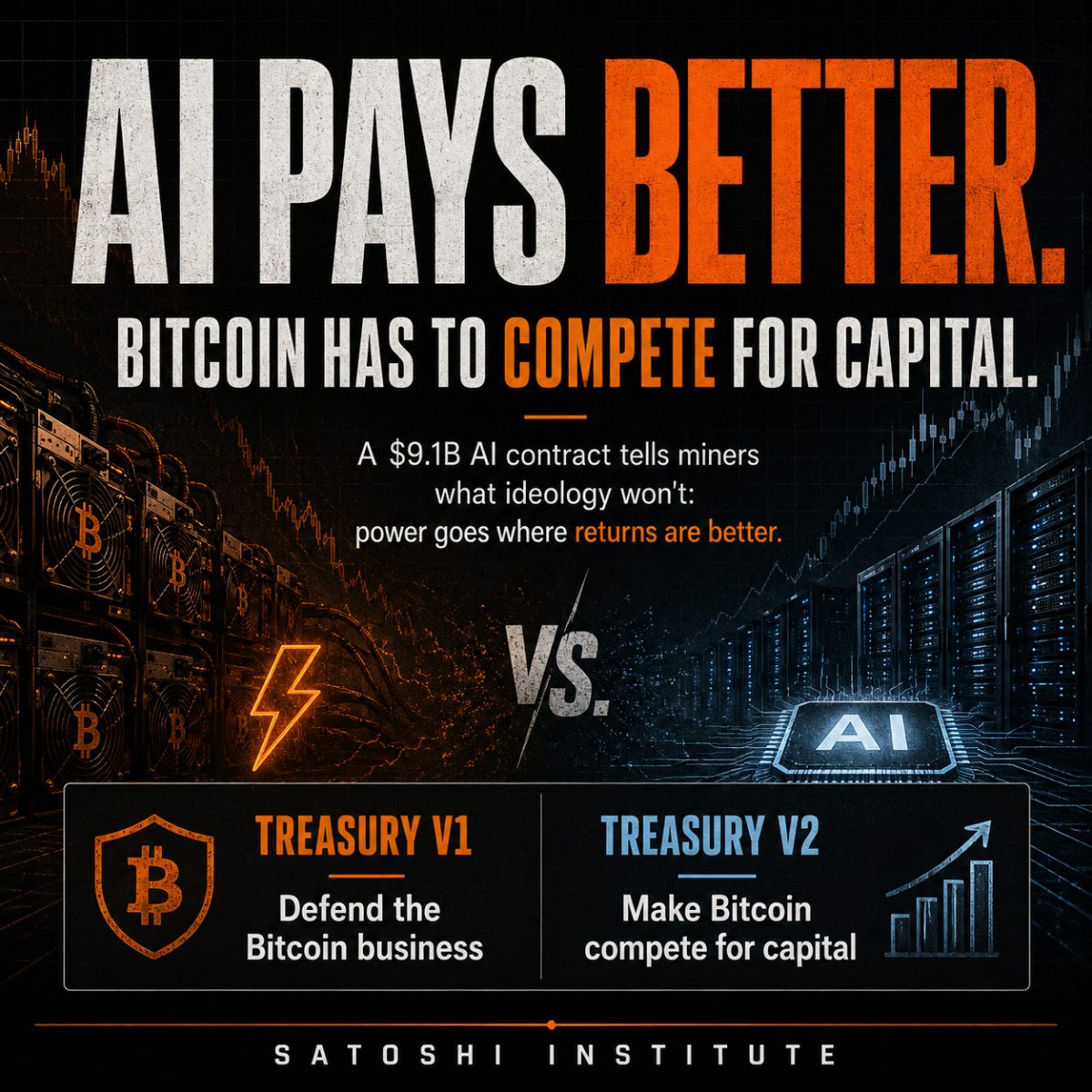
Riot reportedly signed a 20-year AI infrastructure agreement valued at approximately $9.1 billion with what it described as a leading frontier AI lab.
Its current business remains predominantly Bitcoin mining, with $113.7 million of mining revenue versus $23.2 million of data center revenue in the period cited.
But the economics of a long-duration compute contract can change how a board thinks about every megawatt it controls.
Signal: Bitcoin mining now competes internally for power allocation. That competition did not exist at this scale several years ago.
Some miners are leaving before the replacement revenue arrives
Cango's realized hashrate reportedly fell from 44.8 EH/s in Q4 2025 to an estimated 16.5 EH/s in Q2 2026.
Keel Infrastructure went further, completing the decommissioning of its U.S. Bitcoin mining operations in preparation for data center construction.
The awkward part is that replacement revenue has not necessarily arrived yet.
Signal: The transition itself carries risk. Shutting down a known revenue source before the new one produces cash creates an execution gap that boards need to govern explicitly.
The miners that remain may benefit
Mining difficulty has declined as hashrate leaves the network. The analysis argues that remaining miners can earn more Bitcoin per unit of computing power as competition decreases.
Bitdeer is the obvious counterexample to the retreat. Its realized hashrate reportedly increased 44% from Q4 to Q2, reaching 63 EH/s.
Signal: AI does not necessarily kill Bitcoin mining. It may concentrate mining economics among operators with the lowest costs, best machines, or strongest reasons to remain.
What This Actually Means
Calling this "miners abandoning Bitcoin" misses the point. They are reallocating scarce infrastructure. A megawatt can mine Bitcoin or support AI compute. Once one use generates materially better risk-adjusted economics, management has to explain why it chose the other.
That turns Bitcoin mining into a capital-allocation question rather than an identity.
The strongest operators may end up running both. Contracted AI revenue can support the business while Bitcoin mining captures upside when hash economics improve.
Others may leave mining almost entirely.
Either way, the board should care less about ideological purity and more about return on power, liquidity, contract durability, conversion costs, and execution risk.
The ASIC was never the moat. The infrastructure may have been.