
Bitcoin treasury firms found a new slogan. Investors still want economics.
Bitcoin treasury firms found a new slogan. Investors still want economics.
Daily Perspective
The Bitcoin treasury market is moving from accumulation into reinvention.
More than a dozen digital asset treasury companies have reportedly shifted toward AI or data center strategies as Bitcoin prices weakened and treasury premiums collapsed. Yet those pivots have generally failed to restore investor confidence. The sector has lost more than $60 billion in market value, and several companies remain under pressure despite attaching themselves to the market’s newest growth narrative.
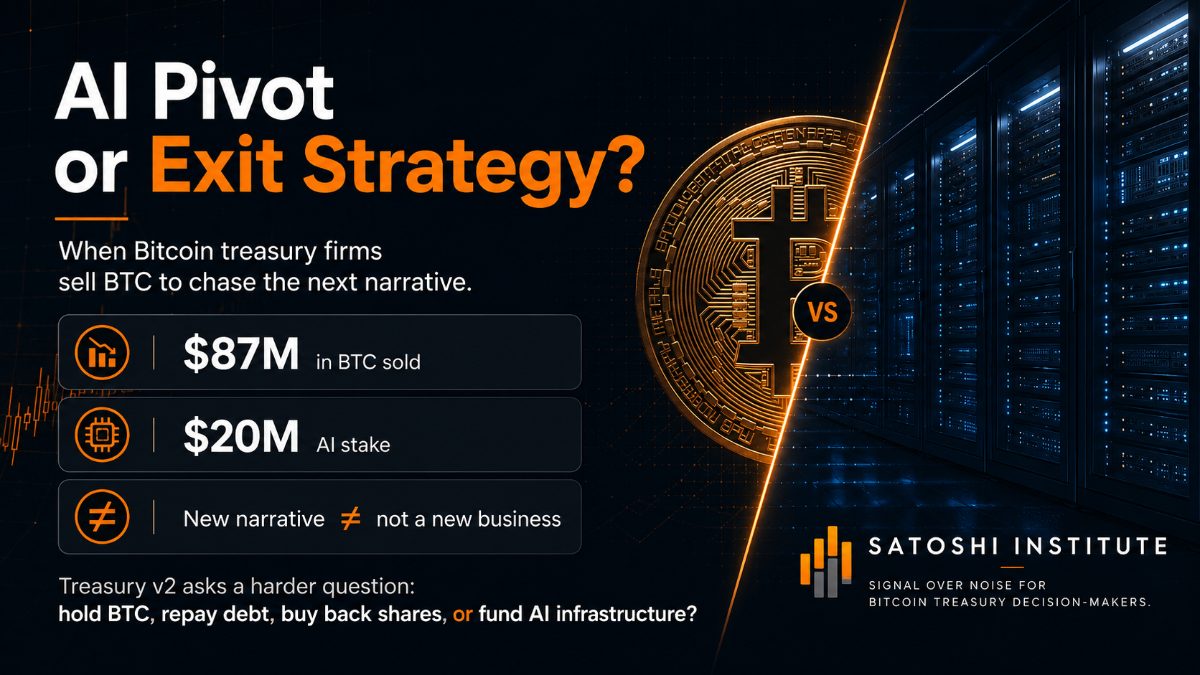
Empery Digital offers the clearest example. It sold 1,400 BTC for roughly $87 million, then invested $20 million in Cardinal Data Power and committed to a much larger data center strategy. That may become a real operating business. At present, several important elements, including capacity, leasing, power delivery, and a separate $65 million property commitment, remain conditional or projected.
The market is no longer asking whether these companies can tell a better story.
It is asking whether they can produce cash flow.
Signals We’re Watching
Market signals
Observed
- Empery completed a $20 million preferred-equity investment for an approximately 8 percent stake in Cardinal Data Power, a developer of powered data center campuses.
- The company previously sold 1,400 BTC for approximately $87 million and still reportedly holds 1,514 BTC alongside about $45 million in debt.
- At least 12 digital asset treasury companies have recently moved toward AI-related businesses, but the pivots have not broadly restored their share prices.
- TD Cowen reduced its price target for Nakamoto by 58 percent, from $40 to $17, citing Bitcoin weakness and concerns about its leveraged capital structure, while reportedly maintaining a Buy rating.
Signal
The treasury premium has stopped rewarding labels. Investors now want evidence that the operating pivot can generate returns after accounting for development costs, debt, dilution, and execution risk.
Capital structure signals
Observed
Empery’s AI strategy now includes several layers:
- A completed $20 million preferred-equity investment
- A proposed larger data center commitment
- Remaining Bitcoin holdings
- Existing debt
- Exposure to development, leasing, and power-delivery milestones
The Midwest data center plan involves a facility with 150 MW of existing capacity and the potential to expand to 300 MW. A proposed $1 billion cloud lease has been described as nonbinding, and Empery’s separate $65 million investment remains tied to conditions.
Signal
Selling Bitcoin to fund an operating business may be rational. Selling Bitcoin to fund a collection of conditional projects is a different proposition.
The board should distinguish invested capital from committed capital, contracted revenue from projected revenue, and available power from aspirational capacity.
Governance signals
Observed
The AI pivot is spreading across companies whose original treasury models depended on rising crypto prices, equity premiums, and continued access to capital. Many are now pursuing data centers, real estate, lending, or other operating activities.
These pivots create new questions:
- Did shareholders fund a Bitcoin treasury or an AI infrastructure company?
- What authority allows management to repurpose treasury assets?
- What return threshold must the new investment meet?
- How will the company measure performance against simply holding the Bitcoin it sold?
- What happens if the AI project requires additional capital?
Signal
A strategic pivot is not automatically diversification. Without board-approved return thresholds and decision rules, it may simply exchange visible Bitcoin volatility for less visible operating risk.
Transparency signals
Tether presents an interesting contrast.
It reportedly holds 97,141 BTC, accumulated under a policy of allocating up to 15 percent of realized operating profits to Bitcoin. Because Tether is private, common public-company valuation measures such as mNAV do not apply cleanly. Yet its accumulation is supported by a profitable operating business rather than repeated issuance of public shares.
That makes Tether difficult to price as a treasury company, but easier to understand economically:
- The operating business generates profit.
- A defined portion of that profit may be allocated to Bitcoin.
- Bitcoin is not required to create the operating cash flow that funds its purchase.
Signal
The strongest Bitcoin treasury may be the one that receives the least attention because it does not need a treasury premium to continue accumulating.
What This Actually Means
AI may be a legitimate operating opportunity.
Demand for powered land, substations, grid access, cooling, fiber, and data center capacity is real. Empery may eventually build a valuable infrastructure platform. Its partners bring energy and real estate experience, and the proposed facility has characteristics that could attract major compute tenants.
But none of that means the pivot should receive an automatic valuation premium.
The Bitcoin treasury model had a simple weakness. Many companies needed the market to value their equity above the Bitcoin they held. That premium allowed them to issue shares, buy more Bitcoin, and report growth in the treasury.
When the premium disappeared, the mechanism stopped working.
Now some of those same companies are adopting AI, another sector where investors have recently rewarded projected future demand. That creates an obvious temptation:
Replace the Bitcoin narrative with the AI narrative.
The problem is that AI infrastructure is not cheaper, simpler, or less risky than Bitcoin accumulation.
It requires:
- Large amounts of capital
- Reliable power access
- Construction and permitting
- Long-term tenant demand
- Cooling and network infrastructure
- Counterparty management
- Financing that can survive delays
Even the largest technology companies are facing investor scrutiny over the scale and cash-flow impact of AI spending. A recent selloff erased hundreds of billions in market value as investors questioned whether rising AI capital expenditure would generate adequate returns.
A small treasury company does not escape those economics by adding “AI data center” to its strategy.
It inherits them.