
The Treasury Boom Is Becoming a Survivor’s Market
The Treasury Boom Is Becoming a Survivor’s Market
Daily Setup / Perspective
The Bitcoin treasury sector is starting to sound less like a gold rush and more like a sorting mechanism.
The freshest quote comes from Strategy CEO Phong Le, who reportedly said the U.S. market may ultimately narrow to just “two or three” Bitcoin treasury companies that survive and win.
That is not a prediction we need to adopt as fact. But the underlying concern is increasingly visible. The easy version of the model was:
raise capital, buy Bitcoin, trade at a premium, repeat.
The harder version is:
maintain capital access, defend the balance sheet through drawdowns, control dilution, service obligations, preserve liquidity, and still create shareholder value when the premium disappears.
That is a very different test. And the latest unwind stories suggest the market is finally starting to administer it.
The Day’s Signals
1. The sector is moving from expansion to consolidation
The most important new conversation is not about who bought Bitcoin this week. It is about how many treasury companies will still matter when this cycle is over. The “two or three survivors” framing is gaining traction because it captures a real structural issue:
Bitcoin itself is not scarce inside this sector.
Durable capital access is.
So is:
- credible management,
- low-cost financing,
- liquidity,
- distribution,
- governance,
- and the ability to increase BTC per share without destroying the shareholder in the process.
2. The treasury boom has destroyed value for many wrappers
The Financial Times and related commentary have focused attention on the amount of equity value lost across companies that pivoted heavily into Bitcoin treasury strategies. The issue is not that Bitcoin disappeared.
It is that many corporate wrappers failed to preserve their premiums, their financing capacity, or their shareholder economics. That distinction matters.
A company can own a scarce asset and still have a weak capital structure around it.
3. Satsuma shows what an unwind actually looks like
Satsuma Technology provides a concrete case study.
Shareholders voted overwhelmingly in July to return all of the company’s capital substantially and cancel its listing. The company then sold its remaining Bitcoin, and the High Court approved the capital reduction in September. Satsuma disclosed proceeds of about £31.9 million from the Bitcoin sale and a realized loss of approximately £1.3 million. Payments to shareholders were expected by 28 September 2026. Investegate
That is not a theoretical stress scenario. That is a treasury strategy ending.
4. The strongest platforms are separating from the wrappers
The emerging market structure is becoming clearer. The likely survivors, whatever their number ultimately is, will need more than Bitcoin.
They will need some combination of:
- lower financing cost,
- better liquidity,
- preferred-capital access,
- operating cash flow,
- strong distribution,
- repeated BTC-per-share accretion,
- and trusted governance.
That is why Strategy keeps being treated differently from smaller imitators. It has a multi-year financing history, multiple security classes, deep trading liquidity and substantial market recognition.
That does not make it immune. It does make the comparison more demanding.
5. The market is starting to price the difference
The treasury trade is increasingly splitting into two categories. One group still commands premium valuations and access to structured capital. The other trades near or below NAV and is increasingly forced to justify why the corporate wrapper exists at all.
That is where consolidation becomes logical.
Smaller companies without a financing advantage may eventually face:
- mergers,
- asset sales,
- capital returns,
- delistings,
- or strategic reversals.
What Does All This Mean
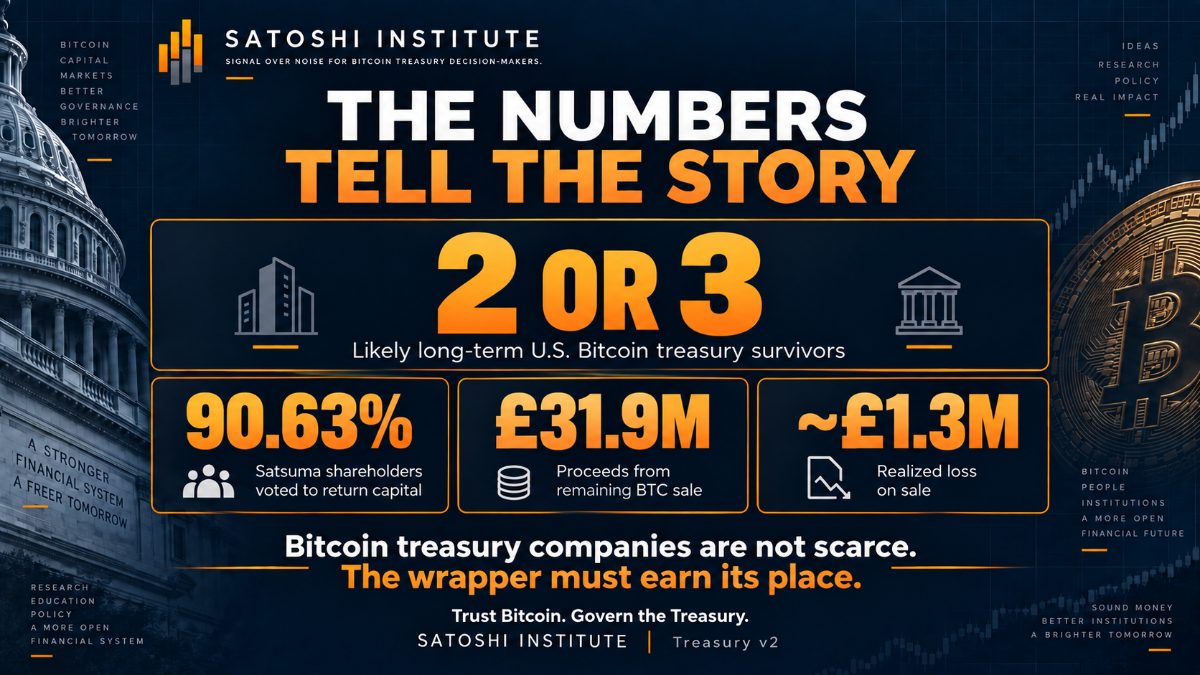
Today’s numbers tell the story:
“2 or 3”
The number of U.S. Bitcoin treasury companies Strategy CEO Phong Le reportedly suggested may ultimately emerge as durable winners.
90.63%
Satsuma shareholder support for returning all capital substantially. Investegate
£31.9M
Proceeds from Satsuma’s remaining Bitcoin sale. Investegate
~£1.3M loss
Realized on that sale. Investegate
28 September 2026
Expected completion date for shareholder repayments. Investegate
The sector is no longer asking only:
Who accumulated fastest?
It is starting to ask:
Who built something durable enough to survive when accumulation stops being easy?
That is the Treasury v2 test.
Bitcoin may be scarce. Durable treasury companies will be scarcer.
Trust Bitcoin. Govern the Treasury.