
The Buying Is Slowing. Now We Find Out What the Model Is Made Of.
The Buying Is Slowing. Now We Find Out What the Model Is Made Of.
Daily Setup / Perspective
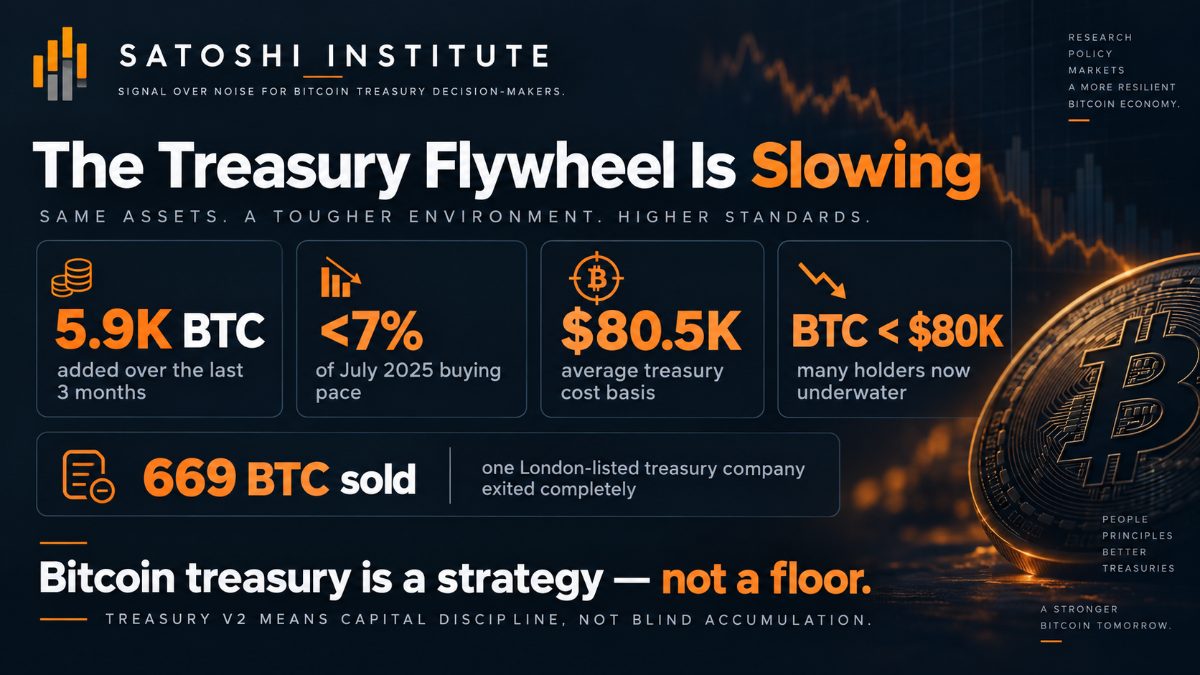
Bitcoin treasury companies added only about 5,900 BTC over the past three months.
That is the number that matters today. Not because corporate demand has disappeared. It has not. But because the pace of accumulation has slowed dramatically from the aggressive buying periods that helped define the Bitcoin treasury boom.
At the same time, many treasury positions are reportedly sitting around an average cost basis near $80,500, while Bitcoin trades below that level.
That creates the first real test of the model. When equity prices are strong and mNAV premiums are generous, raising capital to buy Bitcoin looks remarkably efficient. When the premium compresses, the stock falls, and the treasury moves underwater, the machine has to prove it can still operate.
Treasury v2 begins where easy financing ends.
The Day’s Signals
1. The accumulation engine is slowing
The strongest signal today is not a purchase. It is the absence of purchases. Corporate Bitcoin treasury companies reportedly added only about: 5,900 BTC during the past three months.
One widely circulated comparison put that pace at less than 7% of July 2025 buying levels.
That is a significant slowdown. The issue is not necessarily lack of conviction. It is financing. Many treasury companies depend on:
- common-equity ATMs,
- preferred issuance,
- warrants,
- debt,
- or other capital-market structures
- to continually expand their Bitcoin holdings.
Those mechanisms become considerably less attractive when share prices decline and mNAV premiums compress.
That is the real stress test.
2. The sector is increasingly underwater
The circulating estimate puts the average corporate treasury Bitcoin cost basis around: $80,500 with Bitcoin currently trading below that level. That matters psychologically. But it matters even more structurally.
Paper losses can weaken the financing flywheel. If Bitcoin falls while the company’s equity premium also contracts, the company may simultaneously face:
- lower treasury value,
- weaker share prices,
- less attractive ATM issuance,
- and higher effective financing costs.
That combination can slow accumulation even when management still wants to buy.
3. One company is simply leaving
A London-listed Bitcoin treasury company reportedly sold its entire: 669 BTC position and is returning cash to shareholders. Its listing is also expected to end.
That is a useful reminder. Bitcoin on a corporate balance sheet is not permanent Bitcoin. The asset may be held indefinitely. The corporation may not be.
4. Capital B keeps buying
The slowdown is not universal. Capital B reportedly acquired another: 376 BTC for approximately: $29 million taking total holdings to roughly: 3,521 BTC.
The purchase demonstrates that capital remains available for some companies. But it also reinforces the metric that increasingly matters:
What happened to BTC per diluted share?
More Bitcoin does not automatically mean more Bitcoin economics for every shareholder.
5. ProCap sells Bitcoin to buy back its own shares
Perhaps the most Treasury v2 signal in today’s set is ProCap. The company reportedly sold: 50 BTC and used the proceeds to repurchase shares.
That sounds almost heretical in an accumulation-first world. It is not.
If management believes its own equity is sufficiently undervalued, selling a small amount of Bitcoin to reduce the denominator may actually improve Bitcoin exposure for remaining shareholders.
That is capital allocation.
What This Actually Means
The Bitcoin treasury sector is entering a more revealing phase. For much of the boom, the model benefited from a favorable loop:
high equity premium → raise capital → buy Bitcoin → larger treasury → renewed investor interest → raise more capital.
That loop becomes much harder when the premium contracts.
The current slowdown to roughly 5,900 BTC of net accumulation over three months suggests the sector is beginning to experience that reality. This does not mean the treasury model is broken. It means the model is finally being tested outside ideal financing conditions. And that creates an important distinction.
Some companies built a Bitcoin acquisition strategy. Others may have built a genuine treasury system. A real treasury system can:
buy when financing is attractive,
pause when it is not,
sell when capital is better deployed elsewhere,
repurchase shares when the denominator becomes attractive,
and preserve liquidity when markets turn hostile.
That is a much more demanding standard than simply accumulating Bitcoin. But it is also a much more institutional one.