
25,000 BTC Is Impressive. The Funding Model Is the Story.
25,000 BTC Is Impressive. The Funding Model Is the Story.
Daily Setup / Perspective
Strive just crossed a psychologically important line: 25,000 BTC.
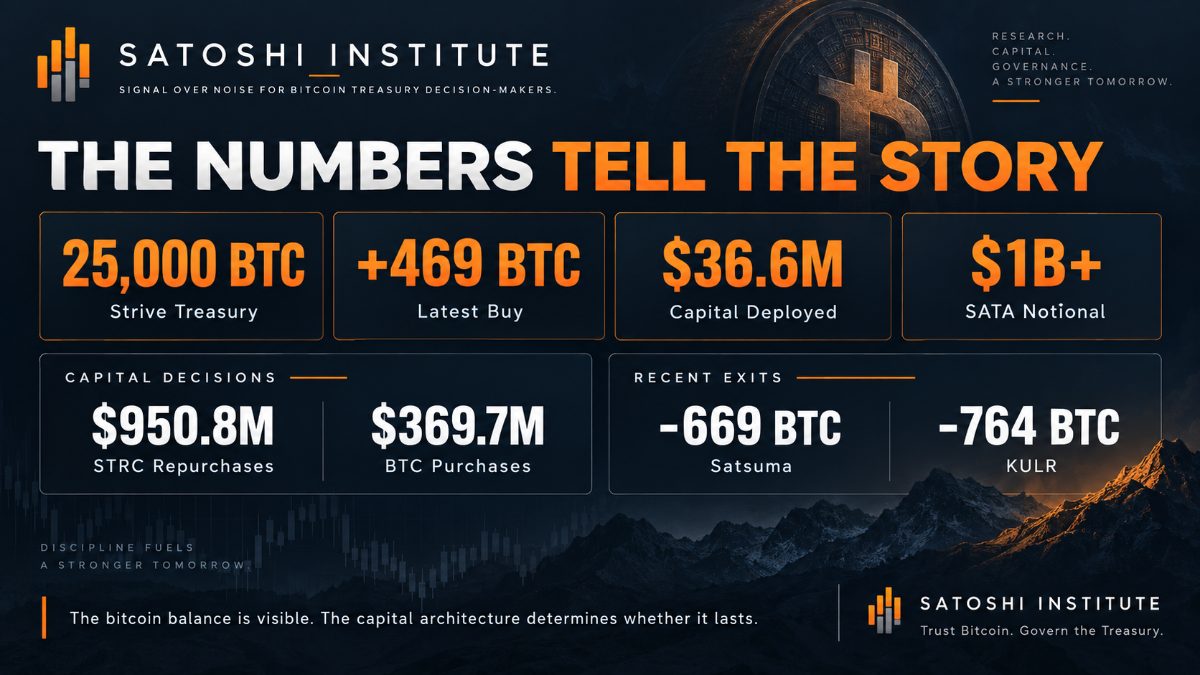
The company reportedly purchased another 469 BTC for roughly $36.6 million, at an average price near $77,954, taking total holdings to exactly 25,000 BTC.
That is the headline. The more important institutional story is how Strive got there.
The latest purchase was reportedly funded through SATA preferred issuance, with SATA notional now exceeding $1 billion. Strive remains debt-free, while continuing to scale its Bitcoin position through preferred capital rather than traditional leverage.
At the same time, Strategy is doing something almost opposite.
Instead of maximizing spot Bitcoin purchases, it has reportedly directed roughly $950.8 million toward STRC repurchases versus approximately $369.7 million toward Bitcoin purchases in the period being discussed.
One company is still building the financing machine. The other is managing the machine it already built.
That is Treasury v2.
1. Strive reaches 25,000 BTC
Strive reportedly bought another: 469 BTC for approximately: $36.6 million at an average acquisition price of roughly: $77,954 per BTC
That brings total holdings to exactly: 25,000 BTC
The round number will get the attention. The financing structure should get the analysis.
The acquisition was reportedly funded entirely through SATA preferred stock, and SATA notional has now crossed the $1 billion threshold. That means Strive is not simply accumulating Bitcoin. It is building a capital-markets product whose purpose is to keep feeding the treasury.
Governance signal
The relevant question is no longer:
Can SATA raise money?
Clearly it can.
The question is:
Can the preferred structure continue increasing BTC per common share after accounting for dividend obligations, warrant dilution and financing costs?
That is where Treasury v2 separates accumulation from value creation.
2. Strategy is prioritizing capital-structure management
Strategy continues to define the benchmark for the sector, but the company’s recent capital allocation is becoming increasingly interesting.
Current reporting says Strategy has deployed approximately: $950.8 million toward STRC repurchases versus roughly: $369.7 million toward Bitcoin acquisitions.
That is a meaningful inversion of the early Strategy model. For years, the operating logic was simple:
- Raise capital.
- Buy Bitcoin.
- Repeat.
Now the company is increasingly allocating capital toward managing the securities that financed the treasury in the first place.
Governance signal
Once a Bitcoin treasury matures, the financing instruments become assets and liabilities that must themselves be governed.
Preferred shares need liquidity. They need investor demand. They need price support. They need dividend capacity. They may eventually compete directly with Bitcoin for capital.
That is not evidence the Bitcoin thesis weakened. It is evidence the capital structure became real.
3. Traditional finance is increasingly treating Strategy as an institution, not an oddity
Strategy has reportedly surpassed Ford in market capitalization and moved to roughly the 200th-largest U.S. public company.
Separately, Barclays reportedly maintained a buy rating with a $160 price target, grouping Strategy alongside major financial-technology companies.
The significance is not the price target itself. It is the analytical shift. Strategy is increasingly being treated not merely as a proxy for Bitcoin, but as a capital-markets company with its own financial architecture.
That is important.
The market is beginning to recognize that the corporate wrapper has economic characteristics beyond the Bitcoin underneath it.
Governance signal
Institutional recognition raises the standard.
The larger and more systemically relevant the treasury becomes, the less acceptable it is to rely on personality, narrative or conviction as substitutes for governance.
Scale creates legitimacy. It also creates accountability.
4. Satsuma shuts down after selling 669 BTC
The accumulation story is not universal.
Satsuma Technology reportedly sold its entire Bitcoin treasury of approximately: 669 BTC and is shutting down.
That is one of the more consequential data points in the current set because it challenges the assumption that corporate Bitcoin adoption is a one-way process.
Some companies will scale.
Some will pause.
Some will restructure.
Some will exit.
Some will fail.
Governance signal
A serious Bitcoin treasury policy must include an exit framework. Not because management intends to sell. Because circumstances change.
Boards should already know:
- what triggers a disposition,
- who approves it,
- what liquidity conditions matter,
- how shareholders are treated,
- and how the decision will be documented.
Permanent accumulation is not governance.
It is an assumption.
5. KULR exits completely
KULR has reportedly sold its remaining approximately 764 BTC for around $59 million and returned its attention to its core battery and energy business.
That is another important signal.
The corporate treasury market is beginning to sort companies according to strategic commitment and economic fit. For some businesses, Bitcoin may remain a permanent reserve asset. For others, it may ultimately prove to be a temporary capital allocation. Neither outcome automatically establishes whether the original decision was good or bad.
The relevant question is whether the strategy was governed.
Governance signal
Treasury v2 does not require permanent Bitcoin ownership.
It requires a defensible process for entering, sizing, financing, holding and eventually reducing a position if circumstances warrant it.
A sale may be disciplined.
An unmanaged sale is not.
What This Actually Means
The Bitcoin treasury market is becoming less uniform. That is healthy.
The early phase produced a simple narrative: More companies. More Bitcoin. More accumulation.
The current phase is producing differentiation. Strive is scaling aggressively through preferred capital. Strategy is managing the preferred structure it already created. Satsuma is exiting. KULR is exiting. Capital B continues accumulating. Metaplanet is addressing governance concerns.
This is no longer one trade. It is a set of competing corporate capital-allocation models. And that means the analytical framework has to change.
The next generation of treasury analysis should compare:
BTC acquired vs capital issued vs financing costs vs fully diluted BTC per share vs liquidity and disposition risk.
The company with the most Bitcoin may not necessarily create the most shareholder value. The company with the cleanest financing machine may.