
Robinhood Bought Bitcoin. That Does Not Make It a Bitcoin Treasury Company.
Robinhood Bought Bitcoin. That Does Not Make It a Bitcoin Treasury Company.
Daily Setup / Perspective
Robinhood has made its first corporate Bitcoin purchase.
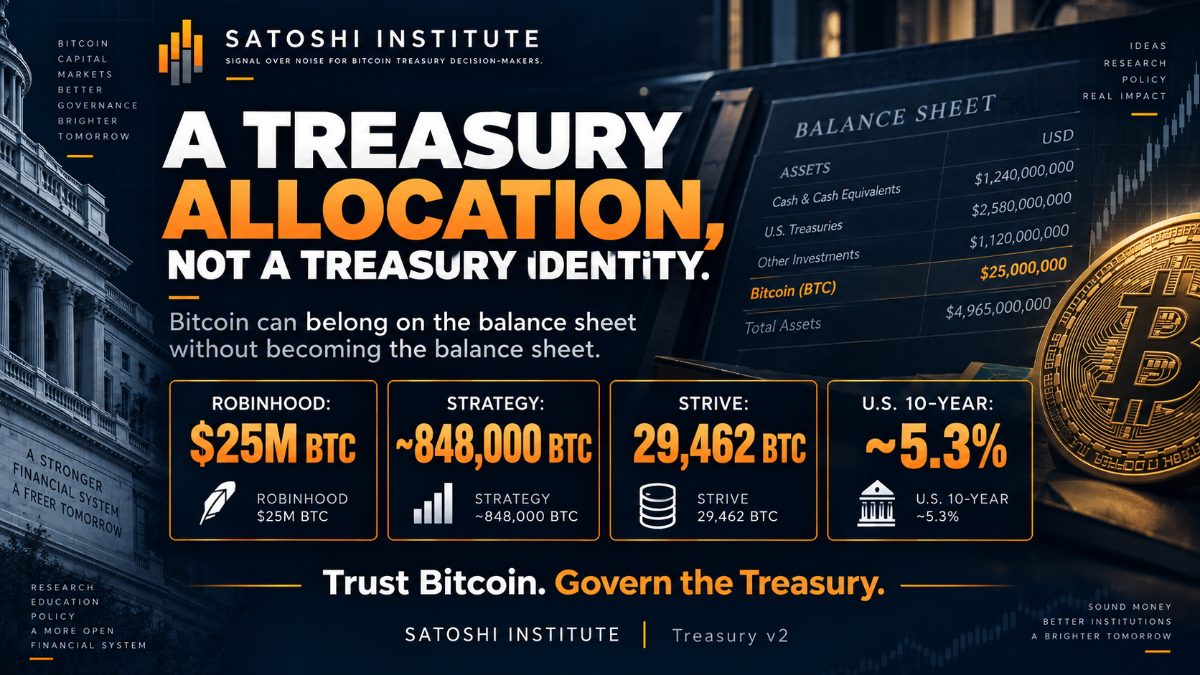
The company added approximately $25 million of BTC to its own balance sheet, separate from customer assets held in custody. Robinhood’s crypto chief Johann Kerbrat described the move as a signal of alignment with Bitcoin and the broader crypto ecosystem. The Block
The important part is the size.
At roughly $25 million, the position is tiny relative to Robinhood’s cash and overall market value. This is not a Strategy-style balance-sheet transformation. And that may be exactly why it matters. Corporate Bitcoin adoption does not have to mean converting the company into a Bitcoin wrapper.
There is another model: an operating company that holds Bitcoin as one governed treasury asset among many.
That distinction deserves more attention.
The Day’s Signals
1. Robinhood puts $25 million of Bitcoin on its own balance sheet
Robinhood has moved from facilitating Bitcoin ownership to owning Bitcoin itself.
The company reportedly purchased approximately $25 million of BTC as a proprietary corporate holding. Yahoo Finance
Kerbrat was also explicit that the purchase is not intended to transform Robinhood into a Bitcoin treasury company.
That makes Robinhood an interesting counterpoint to the pure-play treasury model.
2. Sizing may be more important than conviction
The $25 million allocation represents only a small fraction of Robinhood’s reported corporate liquidity.
That differs sharply from companies where Bitcoin dominates enterprise value and financing strategy.
Robinhood can participate in Bitcoin upside without making corporate survival dependent on Bitcoin.
That creates a fundamentally different risk profile.
3. Strategy buys only 334 BTC, while capital management takes center stage
Strategy purchased: 334 BTC for approximately $28.7 million at an average price of roughly $85,839, bringing total holdings to approximately 848,000 BTC. SEC
That was a relatively small purchase by Strategy standards.
At the same time, Strategy continues to devote significant capital to its preferred-stock complex. Its October 5 filing shows $154.1 million of USD Cash used for STRC repurchases during the September 28 to October 4 period, while only $13 million of USD Cash went toward Bitcoin purchases. SEC
Strategy separately reported $176 million of STRC repurchases in its Q3 update. Strategy
4. Strive adds 2,000 BTC with a different financing engine
Strive purchased another 2,000 BTC at an average price of approximately $84,422, bringing total holdings to 29,462 BTC. SEC
The more interesting feature remains the financing architecture.
Strive is increasingly relying on preferred capital, including SATA, rather than treating common-equity issuance as the only route to accumulation.
That is part of a broader sector shift toward preferred financing as companies attempt to preserve common-share economics.
What This Actually Means
Robinhood may represent a more important model for broad corporate Bitcoin adoption than another pure treasury wrapper. Strategy, Strive and Metaplanet are building businesses increasingly organized around Bitcoin and the securities used to finance it.
Robinhood is doing something simpler. It operates a substantial business. It holds significant liquidity. And it has decided to place a small amount of corporate capital into Bitcoin.
That model potentially scales to a much larger universe of companies.
A corporation does not need:
- a premium mNAV,
- a preferred-stock flywheel,
- a leveraged capital structure,
- or a Bitcoin identity
- to hold Bitcoin.
It needs a policy.
That may be the more consequential next stage of institutional adoption. Not hundreds of companies trying to become Strategy. But thousands of companies determining whether 1%, 2%, or some other governed allocation belongs inside a broader treasury framework.
That is a much more sober conversation. And a much larger addressable market.