
Washington Is Building a Bitcoin Treasury. The Governance Questions Just Got Bigger.
Washington Is Building a Bitcoin Treasury. The Governance Questions Just Got Bigger.
Daily Setup / Perspective
For most of the corporate Bitcoin treasury era, the governance discussion has focused on companies.
Who approves the purchase?
Who controls custody?
Who sets the sale policy?
Who decides when the financing no longer makes sense?
Now the same questions are moving into Washington.
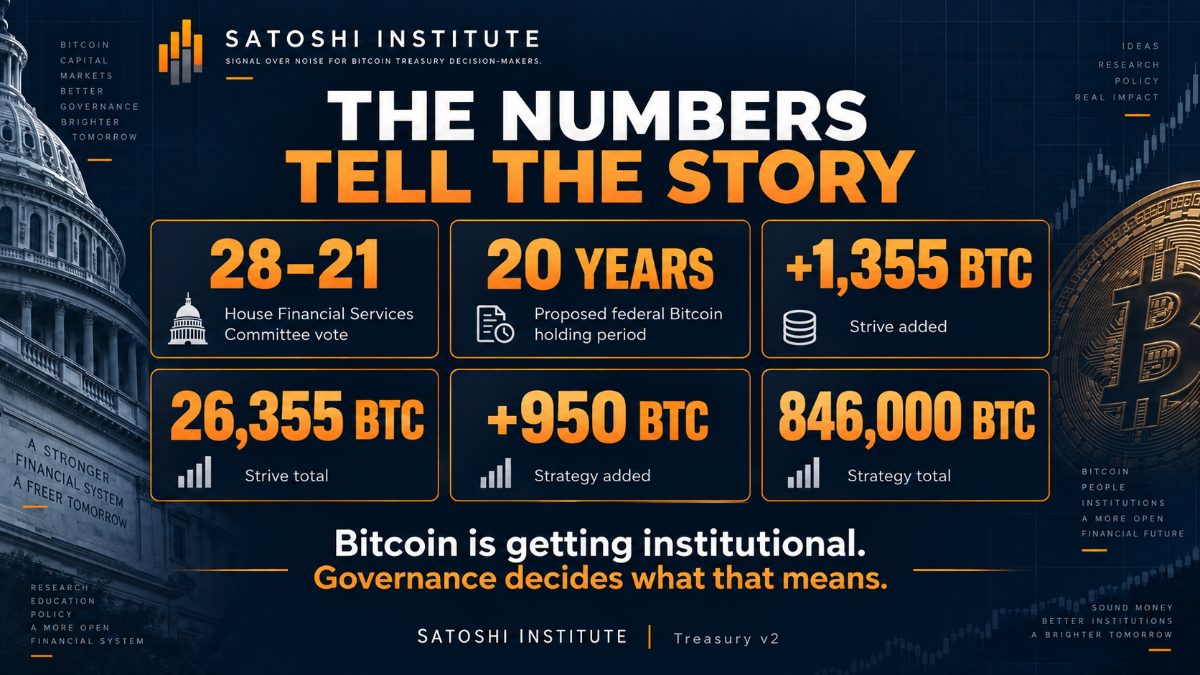
The House Financial Services Committee voted 28-21 to advance H.R. 8957, the American Reserve Modernization Act of 2026. The bill would create a Strategic Bitcoin Reserve at Treasury, impose a 20-year minimum holding period on reserve Bitcoin, and require formal custody, reporting, audit and proof-of-reserve procedures. BillBoard
That is a significant institutional development.
But from a Treasury v2 perspective, the most important part is not simply that the federal government may hold Bitcoin.
It is that lawmakers are attempting to define how it must be governed.
That is the real signal.
Signals We Are Watching
- 1. The U.S. Strategic Bitcoin Reserve moves from policy concept toward statutory structure
H.R. 8957 cleared the House Financial Services Committee by: 28-21
The legislation would place reserve-designated federal Bitcoin under Treasury management and require a minimum: 20-year holding period during which the Bitcoin generally could not be sold, swapped, auctioned or encumbered. BillBoard
The bill also calls for inventory, security, auditing, public reporting and proof-of-reserve requirements. The Civics Project
One important distinction:
Committee approval does not make the bill law. It still requires additional congressional action and enactment before those statutory rules would take effect. CoinDesk
2. The 20-year lock is the headline. The control architecture is more important.
A mandatory 20-year holding period will naturally attract most of the attention. But “never sell for 20 years” is only one policy choice. The more consequential provisions may be the boring ones:
- inventory,
- segregation,
- custody,
- cybersecurity,
- cryptographic attestation,
- audit,
- reporting,
- and oversight.
That is familiar territory for anyone who has followed this newsletter.
Because an asset does not become institutionally credible merely because somebody promises to hold it. It becomes credible when there is evidence showing who has authority, where the asset is, what controls protect it and what rules govern disposition.
3. Coinbase involvement is getting attention, but the claims need to stay carefully framed
Reports circulating over the weekend say Coinbase is discussing the Strategic Bitcoin Reserve with U.S. Treasury and Commerce officials.
That reporting is generating substantial attention, but the details remain less firmly documented than the committee vote itself. Current secondary reporting describes discussions involving Coinbase leadership and federal officials, while the publicly verified legislative development is the committee advancement of H.R. 8957. TheStreet
Governance signal
Private-sector participation in federal custody, infrastructure or execution would raise another layer of questions:
- vendor selection,
- conflicts,
- custody architecture,
- concentration risk,
- operational resiliency,
- and auditability.
A government Bitcoin reserve is not simply a wallet. It is an institutional control environment.
What This Actually Means
The Bitcoin treasury conversation is becoming institutional at two levels at once. At the corporate level, companies such as Strive and Strategy are building increasingly complex financing systems around Bitcoin. At the federal level, Congress is now debating a statutory governance structure around government-held Bitcoin.
Those are different institutions.
But the underlying problem is remarkably similar. How do you hold a volatile, scarce asset inside an organization that must remain accountable to other people?
For a corporation, those people are shareholders, creditors, boards and auditors. For government, they are taxpayers, Congress, oversight bodies and future administrations. In both cases, Bitcoin does not eliminate governance.
It makes governance more important.
And that may be the larger institutional shift. The market spent years debating whether Bitcoin belonged on serious balance sheets. The next debate is about the rules required once it gets there.