
Bitcoin Fell 54%. The Treasuries Didn’t Break.
Bitcoin Fell 54%. The Treasuries Didn’t Break.
Perspective
For months, the loudest criticism of Bitcoin treasury companies was that a sufficiently severe Bitcoin drawdown would force them into liquidation.
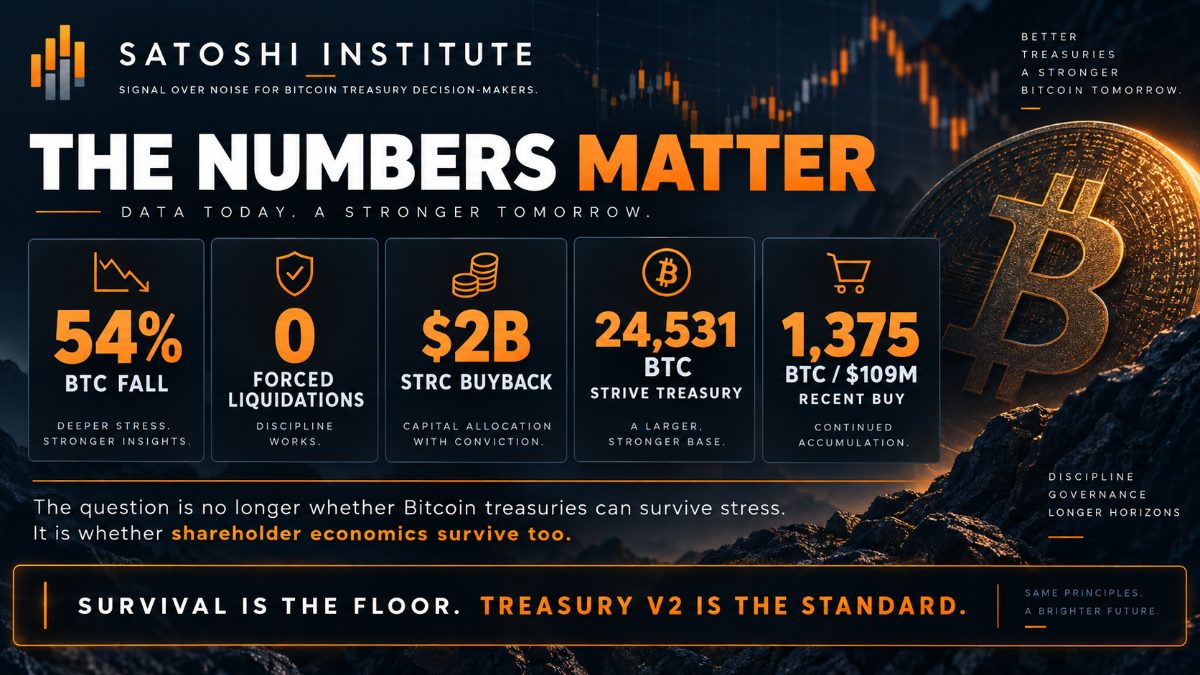
Then Bitcoin fell roughly 54% from its October 2025 high into mid-2026.
And according to the reporting in today’s news set, the major corporate Bitcoin treasuries recorded zero forced liquidations.
That deserves attention.
Not because it proves every Bitcoin treasury model is sound. It does not.
It proves something more useful:
The first generation of balance-sheet structures was more resilient to Bitcoin price stress than many critics expected.
But surviving a drawdown is not the same thing as creating shareholder value through it.
That is where the next test begins.
Signals We Are Watching
1. Bitcoin fell 54%. Forced liquidations: zero.
The cleanest number in today’s news set is: -54% Bitcoin drawdown
versus 0 forced corporate treasury liquidations.
That matters.
Corporate treasuries holding hundreds of thousands of Bitcoin collectively endured a decline that, under the simplest bear-case narrative, should have forced leveraged holders to dump coins into a falling market.
That apparently did not happen. The lesson is not that leverage is harmless. It is that the structure of the leverage matters. Long-dated obligations, unsecured financing, preferred equity, cash reserves and the absence of automatic mark-to-market triggers can produce very different outcomes from highly margined trading leverage.
Governance signal
Treasury risk should not be measured by leverage alone.
Boards need to understand:
- What triggers repayment?
- What can create forced selling?
- What collateral is pledged?
- What maturities exist?
- What liquidity must be maintained?
A 54% drawdown is a stress test. Apparently, several major treasury structures passed the liquidation test. That is meaningful.
2. Surviving the drawdown does not mean the equity survived economically
The fact that Bitcoin was not forcibly liquidated does not mean shareholders experienced the same resilience. Today’s market commentary notes periods in which Bitcoin treasury equities underperformed Bitcoin itself, including Strategy lagging BTC even on positive Bitcoin days.
That distinction is central. Bitcoin can recover.
The corporate wrapper may still suffer from:
- premium compression,
- higher financing costs,
- preferred obligations,
- share dilution,
- mNAV contraction,
- or reduced investor appetite.
Governance signal
There are at least two different survival tests:
Can the company keep the Bitcoin? and can the shareholder preserve attractive economic exposure to Bitcoin?
Treasury v1 concentrated on the first. Treasury v2 needs both.
3. STRC exposes the difference between supporting a security and fixing a product
Strategy reportedly doubled its STRC repurchase authorization to: $2 billion.
The argument in the Bitcoin Balance Sheet discussion is that buybacks alone may not return STRC to par. That deserves a closer look. A buyback reduces outstanding claims and can provide price support. But if investors believe the security itself is less attractive than alternatives, buying more of it does not necessarily solve the underlying problem.
The comparison increasingly being made is with Strive’s SATA. The cited discussion points to SATA’s: 13% yield and daily distribution and a reported: 13-day streak near $100 par.
The claim is straightforward:
Investor demand may be responding not merely to issuer strength, but to product architecture.
Governance signal
This is no longer simply a Bitcoin treasury discussion. It is capital-market product design. A treasury company issuing preferred securities must ask:
Why should an investor own this particular claim?
Yield matters.
Payment frequency matters.
Liquidity matters.
Issuer credibility matters.
Balance-sheet simplicity matters.
Buybacks can support a product.
They cannot substitute indefinitely for making the product competitive.
4. Strive is demonstrating the other side of the preferred-financing machine
The recent Strive story has been dominated by the Bitcoin acquired. Its treasury has risen rapidly to approximately: 24,531 BTC with a recent acquisition of: 1,375 BTC for about $109 million.
But the financing architecture deserves equal attention. Recent reporting says SATA issuance added almost: $12 million in annualized preferred-dividend obligations in roughly one week.
This is where the capital-market machine becomes interesting. The same instrument helping Strive acquire Bitcoin also creates a recurring obligation that must ultimately be serviced.
Governance signal
The question is no longer: Can preferred capital buy Bitcoin? Clearly it can.
The harder question is: Can the Bitcoin treasury generate enough economic advantage to justify the permanent financing cost attached to it?
That is a Treasury v2 calculation.
What This Actually Means
The Bitcoin treasury sector may have just passed its first genuinely meaningful institutional stress test. Bitcoin fell approximately 54%. The major corporate treasury structures did not apparently experience forced liquidation.
That is significant.
But it would be a mistake to declare victory. The market is already moving to the next layer of scrutiny. The questions are becoming:
- What did it cost to survive?
- How much dilution occurred?
- How did preferred securities perform?
- How much cash had to be retained?
- Did mNAV hold?
- Did BTC per share improve?
- Did the shareholder outperform simply owning Bitcoin?
And perhaps most importantly:
Can the capital structure function through the next cycle without requiring favorable markets to repair it?
That is a much higher bar.