
Holding Bitcoin is no longer the whole treasury strategy
Holding Bitcoin is no longer the whole treasury strategy
Daily Perspective
Bhutan’s Gelephu Mindfulness City plans to put part of its pledged 10,000 BTC treasury into a market-neutral strategy managed by 3iQ.
Strategy sold another 1,638 BTC, issued more common stock, repurchased STRC, and raised its dollar reserve to roughly $4 billion. Hyperscale Data monetized about 150.5 BTC while continuing to describe Bitcoin as an anchor for its AI data center strategy.
Three very different institutions. One shared development.
Bitcoin is no longer sitting quietly in the reserve column. It is being deployed, sold, pledged, monetized, and used to support wider financial objectives.
That may be progress. It also means the word "treasury" is doing considerably more work than it used to.
Signals We’re Watching
Bhutan moves from holding to managed deployment
Gelephu Mindfulness City reportedly plans to have 3iQ manage part of its Bitcoin treasury through a market-neutral strategy.
The appeal is understandable. A market-neutral mandate may produce returns without requiring a directional Bitcoin bet, allowing the city to generate income while retaining long-term exposure.
The governance burden changes immediately.
The treasury now carries manager risk, counterparty risk, strategy risk, liquidity terms, custody questions, and performance benchmarks. "Market neutral" describes the intended exposure. It does not mean risk free.
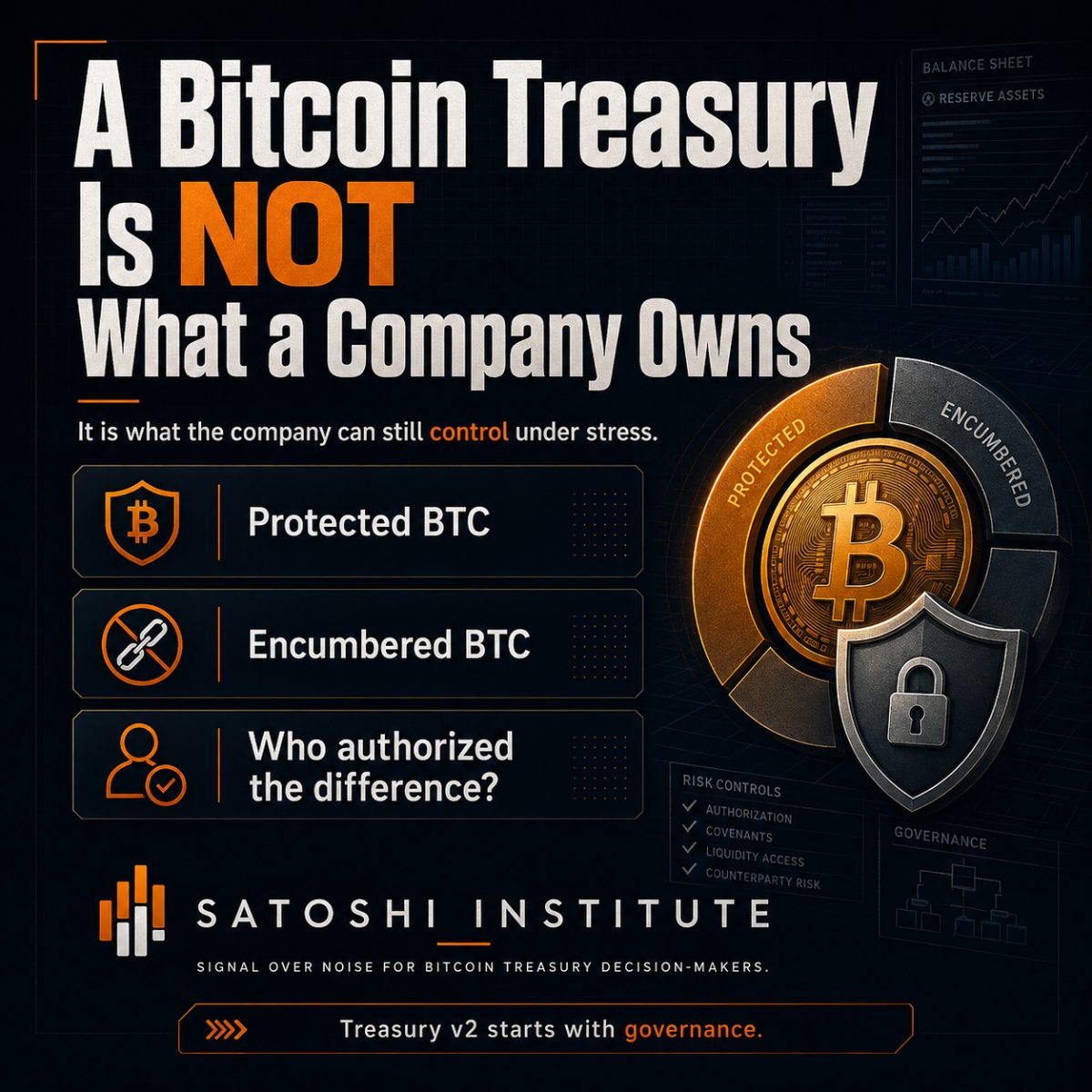
The board-level question is no longer simply how much Bitcoin the city holds.
It is how much remains unencumbered, liquid, and available when needed.
Strategy sells Bitcoin while strengthening STRC
Strategy sold 1,638 BTC for approximately $104.7 million and repurchased 912,143 STRC shares for roughly $81.2 million. It also issued about 3.01 million MSTR shares and increased its dollar reserve to approximately $4 billion.
Its reported Bitcoin holdings declined to 842,138 BTC.
The transaction makes the hierarchy clearer. Strategy is willing to reduce the Bitcoin stack and dilute common shareholders to strengthen liquidity and support the preferred capital structure.
That is active treasury management.
It is also a reminder that preferred holders, common shareholders, cash reserves, and the Bitcoin treasury now compete for the same capital.
Hyperscale monetizes Bitcoin for operating flexibility
Hyperscale Data reportedly monetized approximately 150.5 BTC, reducing its treasury to about 959 BTC.
The company operates an AI data center business alongside its Bitcoin strategy. Selling part of the treasury may provide capital for operations, development, or other strategic needs.
That does not automatically make the sale good or bad.
The relevant test is whether the Bitcoin was sold under a defined capital-allocation policy, whether the proceeds have a disclosed use, and whether the expected return exceeds the value of retaining the BTC.
Bitcoin can support the business.
It can also become the business’s easiest source of emergency cash.
The market appears less alarmed by Strategy’s sales
Bitcoin reportedly remained near $64,000 despite Strategy’s latest sale.
That suggests the market may be adjusting to Strategy as both a buyer and seller rather than treating every disposal as a crisis.
This is healthy for price discovery. It also changes the narrative around corporate demand.
A company holding more than 4 percent of Bitcoin’s eventual supply cannot sell without attracting attention. The market must now price both sides of Strategy’s treasury policy, not merely assume permanent accumulation.
Smaller treasuries continue adding
OranjeBTC reportedly added 30 BTC, bringing its holdings to approximately 3,948 BTC.
This illustrates the growing divergence in the sector.
Some companies are accumulating. Others are monetizing. Strategy is actively reshaping liabilities. Bhutan is exploring managed yield.
Raw treasury rankings tell us who holds the most Bitcoin.
They reveal very little about why the Bitcoin is held, how much is available, or what claims sit against it.
What This Actually Means
August’s Treasury v2 theme is operational integration.
Today’s developments fit it almost too neatly.
Bitcoin is moving from a separate strategic reserve into the operating machinery of institutions. It is being used to produce income, support preferred securities, fund business expansion, repay obligations, and preserve liquidity.
That integration can make the treasury more useful.
It can also make it harder to understand.
A passive Bitcoin reserve has a relatively simple risk profile. The price changes. Custody matters. Governance determines access and authority.
An active treasury introduces more layers.
A market-neutral strategy may involve derivatives, financing counterparties, collateral movements, and manager discretion. A sale to support preferred securities changes the distribution of value among stakeholders. Monetizing Bitcoin for an AI business converts liquid reserve exposure into operating and construction risk.
The risk does not disappear.
It changes address.
Bhutan’s plan deserves particular attention because sovereign and quasi-sovereign treasuries have different obligations from public companies. A public company is accountable to shareholders. A city or national institution must also consider public purpose, intergenerational value, transparency, and political legitimacy.
The relevant questions include:
- What portion of the treasury may be deployed?
- What portion must remain unencumbered?
- Which counterparties are permitted?
- What losses or drawdowns trigger suspension?
- How is performance measured against simply holding Bitcoin?
- Who has authority to change or terminate the mandate?
Without those answers, "putting Bitcoin to work" risks becoming a polite phrase for adding complexity.
Strategy’s actions show the corporate version of the same issue.
The company is no longer maximizing total BTC at every opportunity. It is managing a financial platform with common equity, preferred securities, cash reserves, and Bitcoin holdings. Selling BTC to repurchase STRC may improve dividend economics and market confidence in the preferred product.
It may also reduce Bitcoin per share and impose dilution on common holders.
Both can be true.
Hyperscale presents the operating-company version. Bitcoin may provide useful optionality for an AI infrastructure business, but every monetization decision should be evaluated against the return expected from the operating use of proceeds.
Selling a reserve asset is easy.
Proving that the replacement investment created more durable value takes longer.