
Metaplanet Sold 10,000 BTC. Then Bought Back 11,000.
Metaplanet Sold 10,000 BTC. Then Bought Back 11,000.
Daily Setup / Perspective
The loudest Bitcoin treasury story today is not accumulation. It is liquidity.
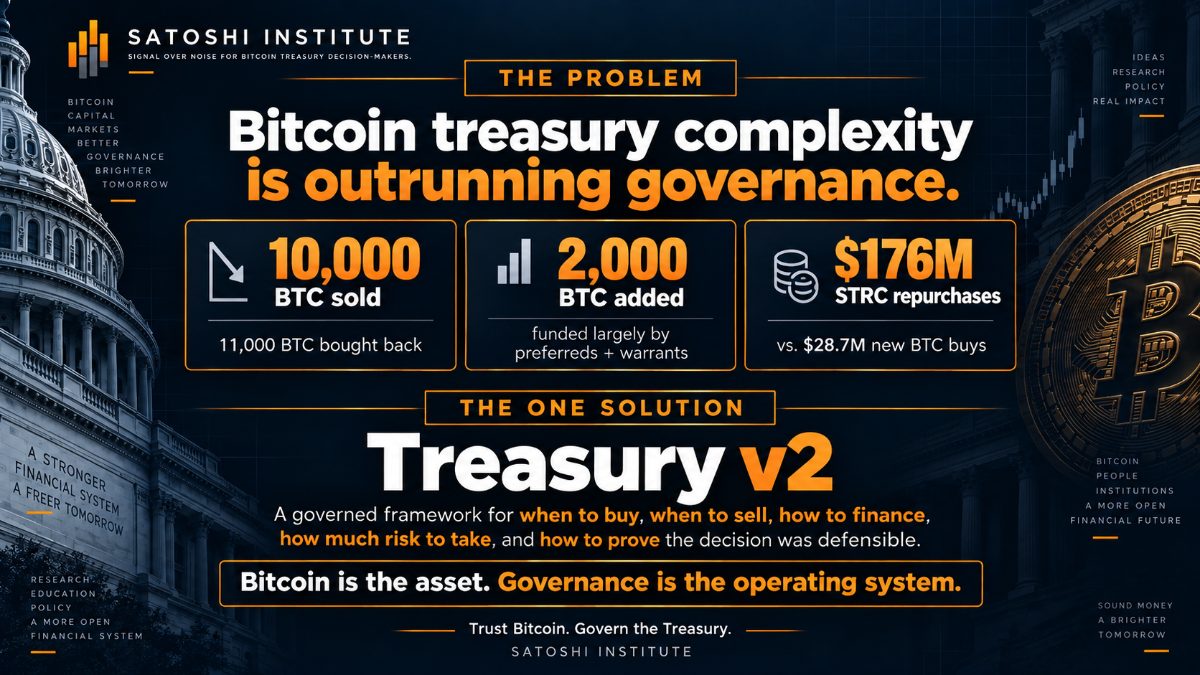
Metaplanet disclosed that it sold 10,000 BTC during Q3, then later repurchased 11,000 BTC, leaving the company with a net gain of +1,000 BTC and total holdings of 44,000 BTC.
At first glance, selling around $79,000 and rebuying around $86,000 sounds like the kind of trade nobody puts on the investor-relations highlight reel.
But the market is interpreting it differently.
The transaction is being framed as proof that a large Bitcoin treasury can be converted into cash, used to satisfy balance-sheet requirements, and then rebuilt. That is more interesting than another “we bought Bitcoin” headline.
Because Treasury v2 has always asked a harder question:
Can the treasury actually function when the company needs liquidity?
Metaplanet just attempted to answer that in the real world.
The Day’s Signals
1. Metaplanet sells 10,000 BTC and buys back 11,000
The numbers are hard to miss: 10,000 BTC sold, followed by 11,000 BTC repurchased, for a net increase of 1,000 BTC and total holdings of 44,000 BTC.
That places Metaplanet ahead of Twenty One Capital at roughly 43,500 BTC in the current ranking discussion.
But the ranking is secondary.
The key signal is that Metaplanet deliberately showed Bitcoin could serve as a liquidity source without permanently shrinking the treasury.
2. The liquidity proof may matter more than the price paid
The round trip naturally attracts criticism.
Selling near $79,000 and rebuying around $86,000 means Metaplanet paid more to rebuild the position than it received when it sold.
That is real economic friction.
But if the purpose was to demonstrate liquidity to rating agencies, lenders, or other capital providers, management may view that cost as part of establishing a stronger financing platform.
That is a very different calculation from simply trying to trade Bitcoin profitably.
3. Metaplanet is becoming more than a Bitcoin accumulator
The new structure matters. Metaplanet reportedly intends to keep approximately 85–90% of assets in Bitcoin, with roughly 10–15% allocated to an income-generating portfolio.
That income sleeve is expected to include preferred securities issued by other Bitcoin treasury companies. In other words, Metaplanet may increasingly earn money from financing the same sector in which it operates.
4. Strive adds 2,000 BTC, but the financing mix is the better number
Strive reportedly purchased 2,000 BTC for approximately $169 million at an average price near $84,400, bringing total holdings to 29,462 BTC.
That is a substantial acquisition. But again, the more interesting detail is how it was financed.
Roughly: 61% of the funding reportedly came from SATA preferred sales and warrant exercises rather than common-equity issuance.
That matters.
The Bitcoin treasury market is steadily moving away from the original model: sell common stock → buy BTC toward increasingly layered capital structures.
5. Strategy buys only 334 BTC while spending far more on STRC
Strategy reportedly added 334 BTC for approximately $28.7 million. Its holdings are now around 848,000 BTC.
But during the same general period, Strategy reportedly spent approximately $176 million on STRC preferred repurchases.
That is more than six times the capital deployed into new Bitcoin. This is now becoming a recurring pattern worth watching.
What This Actually Means
The treasury sector is moving beyond the simple “buy and hold” phase. Metaplanet sold Bitcoin to prove liquidity and then rebuilt the position. Strive is increasingly financing accumulation through preferred capital. Strategy is allocating more capital toward managing STRC than toward new Bitcoin purchases.
Those are three different companies making three different capital-allocation decisions. That is exactly what a maturing market should look like. The early treasury model implied that all good decisions pointed in one direction: more Bitcoin.
Treasury v2 says something different:
The best decision depends on the company’s:
- capital structure,
- liquidity,
- financing cost,
- shareholder economics,
- risk limits,
- and strategic objectives.
Sometimes that means buying.
Sometimes it means selling.
Sometimes it means buying back preferreds.
Sometimes it means maintaining cash.
The discipline is not in doing the same thing every time.
The discipline is in knowing why the decision changed.