
Strategy’s balance sheet is no longer simple. That may be the point.
Strategy’s balance sheet is no longer simple. That may be the point.
Daily Perspective
Strategy’s Q2 call made one thing clear.
The company is no longer operating as a simple Bitcoin accumulation vehicle.
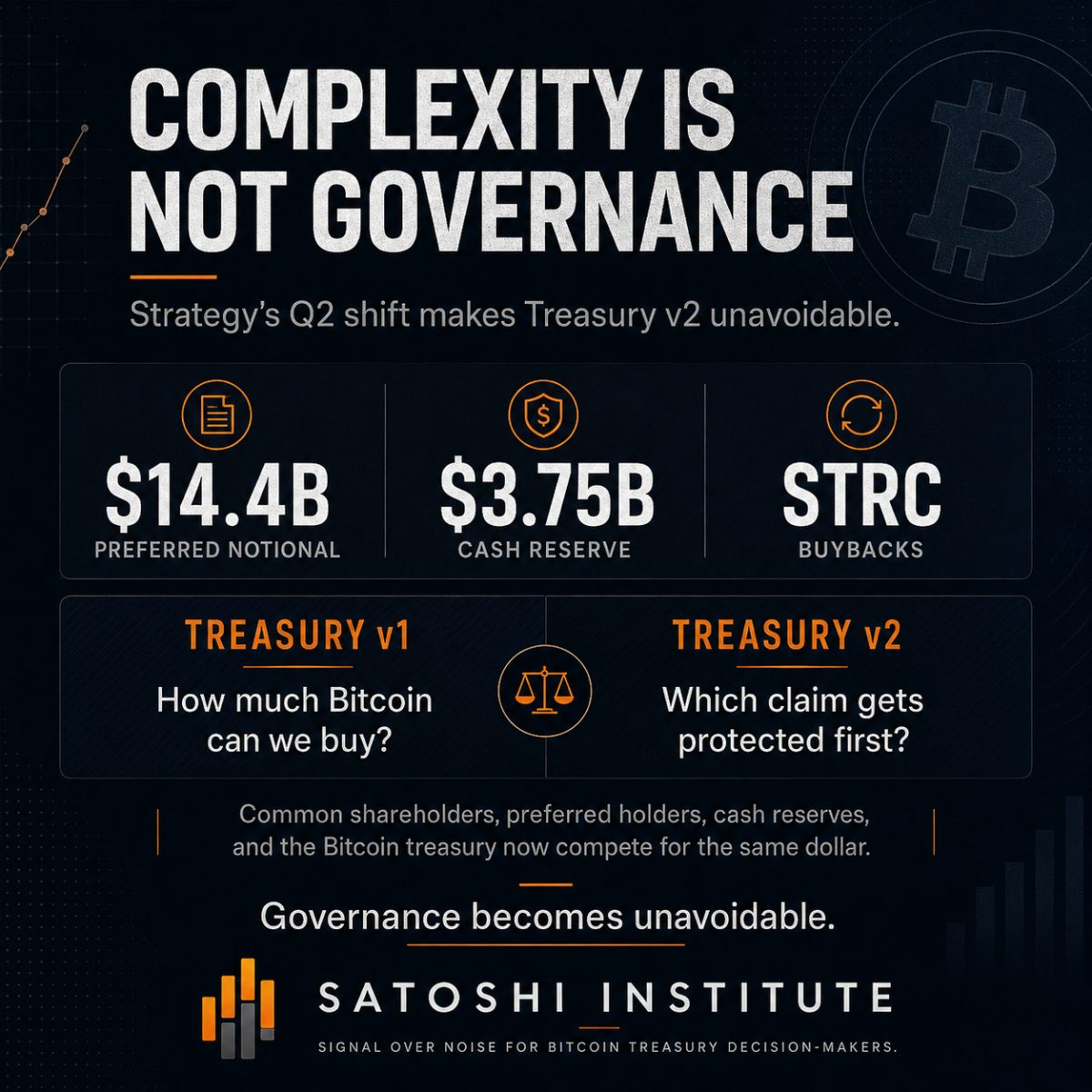
Preferred notional rose from $9 billion to $14.4 billion. Cash reached a record $3.75 billion. Management emphasized optionality, multi-year liquidity, STRC buybacks, and a path back to par.
That is not the old playbook.
It is a far more sophisticated capital structure. Which also means it comes with far more ways to get the governance wrong.
Signals We’re Watching
Strategy is prioritizing optionality
Strategy is building a larger dollar reserve and using buybacks to support STRC rather than relying on higher dividends alone.
That matters because management is no longer treating Bitcoin accumulation as the only objective. It is now balancing preferred pricing, dividend coverage, cash reserves, dilution, and future financing access.
The company did not abandon the Bitcoin thesis.
It added a second assignment: make the financing architecture survive it.
Preferred notional is growing faster than the simplicity of the story
Preferred notional increased from $9 billion to $14.4 billion during the quarter, driven largely by STRC.
That creates greater funding capacity, but it also adds fixed cash obligations, investor expectations, and another layer of claims against the corporate structure.
A larger preferred stack can support Bitcoin ownership.
It can also make future management decisions less flexible if cash generation, equity access, or market confidence weakens.
The instrument may be perpetual.
The need to pay it is not theoretical.
Cash has become a strategic asset
Strategy’s $3.75 billion cash reserve gives it a multi-year runway for preferred dividends and other obligations.
That is a notable shift.
For years, excess cash was treated as inefficient capital that should become Bitcoin. Now cash is being used to defend the credit platform, preserve optionality, and reduce the risk of forced action.
Treasury v1 saw cash as idle.
Treasury v2 sees cash as time.
STRC is becoming the center of the model
Management appears to be simplifying the preferred platform around STRC and using buybacks to move it back toward par.
That is more disciplined than simply raising the dividend every time the market price weakens. It reduces outstanding claims, supports the instrument, and may improve future issuance conditions.
But the strategy still depends on careful capital allocation.
Repurchasing STRC helps preferred holders.
Funding those repurchases through common share issuance shifts the cost elsewhere.
The balance sheet improves in one place and becomes more diluted in another.
Strategy is treating Bitcoin as a working treasury asset
Reports around a larger Bitcoin sale authorization created confusion, but management has clarified that Strategy intends to remain a net buyer over time.
The more important development is not whether Strategy sells or buys in any particular week.
The important development is that Bitcoin is now one component inside a managed capital system.
It may be bought, held, sold, or used to support obligations depending on what the board and management believe best protects the wider structure.
That is a mature treasury posture.
It is also very different from "never sell."
What This Actually Means
Strategy’s Q2 call revealed a company moving from accumulation to orchestration.
The original model was easy to explain.
- Raise capital.
- Buy Bitcoin.
- Repeat.
The new model has more moving parts.
Management must now decide how much cash to hold, how aggressively to issue common equity, how much preferred exposure to build, when to repurchase STRC, whether to sell Bitcoin, and how to protect the company’s ability to remain a net buyer.
That complexity is not automatically bad.
Large institutions are complex because they manage competing obligations.
The danger arrives when complexity grows faster than governance.
Strategy’s preferred notional now exceeds $14 billion. That means the company has created a large class of investors whose primary concern is not Bitcoin appreciation. They care about income, liquidity, par stability, and confidence that the issuer can meet its obligations.
Common shareholders care about something different.
They want Bitcoin per share, upside participation, and protection from dilution.
The company must satisfy both groups while preserving the Bitcoin treasury.
That is not a simple balancing act.
It is a capital-allocation conflict built into the structure.
The larger cash reserve helps. It gives management time and reduces the chance that a short-term drawdown forces a Bitcoin sale. It also means billions of dollars are sitting outside Bitcoin, which reduces immediate amplification.
Again, there is no free answer.
- More cash improves resilience.
- Less cash improves exposure.
- More preferred issuance expands financing capacity.
- Less preferred issuance reduces fixed obligations.
- More common issuance builds liquidity.
- Less common issuance protects existing shareholders.
Treasury v2 does not pretend these tensions can be eliminated.
It requires the board to define which objective takes priority under which conditions.
That is the part the market should be watching now.
Not the next Bitcoin purchase. The hierarchy behind it.