
The Biggest Risk May Not Be Bitcoin. It May Be the Index Committee.
The Biggest Risk May Not Be Bitcoin. It May Be the Index Committee.
Daily Setup / Perspective
Bitcoin treasury companies have spent years worrying about Bitcoin.
Now they may need to worry about the institutions that decide whether their shares belong inside the machinery of global capital markets.
The loudest signal today is the dispute around MSCI’s methodology for digital-asset treasury companies.
According to the Bitcoin Policy Institute’s analysis, MSCI previously considered excluding companies with at least half of their assets in digital assets, shelved that approach, and later returned with a broader test focused on whether certain companies should be classified as “non-operating.”
MSCI’s own simulation reportedly shows that such a methodology could exclude companies including Strategy and Metaplanet.
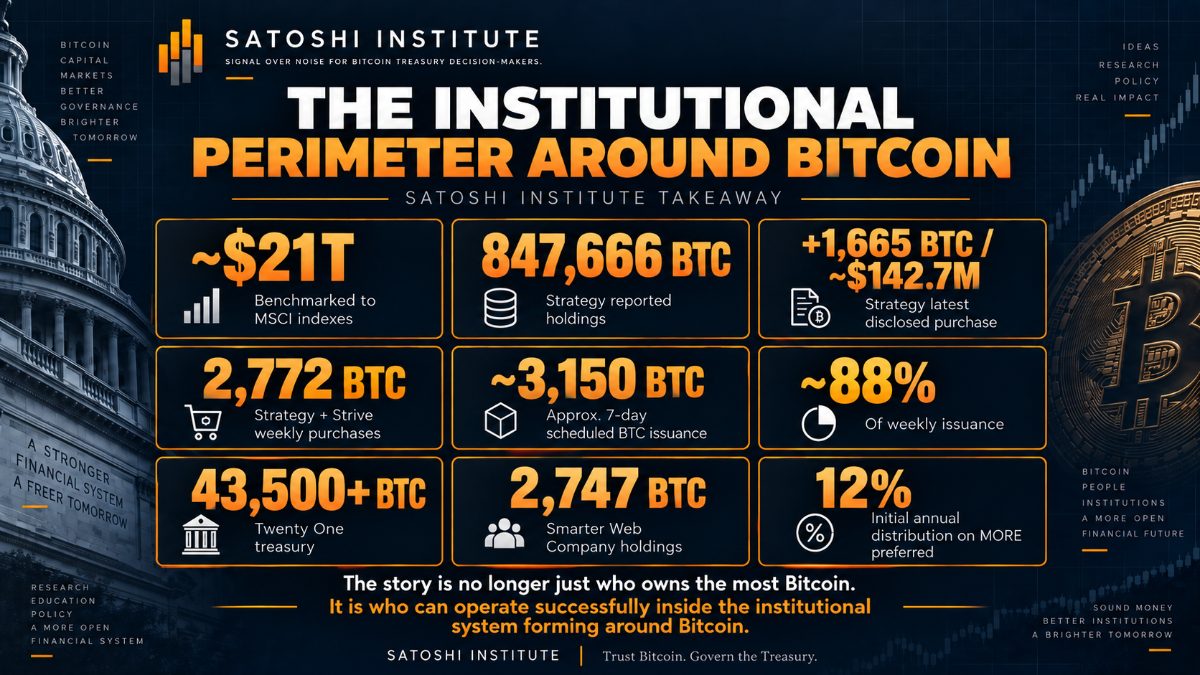
That matters because approximately $21 trillion is benchmarked to MSCI indexes.
A Bitcoin treasury company can manage custody perfectly.
- It can control leverage.
- It can preserve liquidity.
- It can even increase BTC per share.
- And then an index methodology can change.
That is Treasury v2 territory. The risk is no longer just inside the company. It is increasingly inside the institutional perimeter around it.
The Day’s Signals
1. MSCI is becoming a treasury risk factor
The Bitcoin Policy Institute’s paper, “Wall Street’s Invisible Committee,” has pushed an issue that most treasury investors rarely think about into the center of the conversation.
Index eligibility.
MSCI reportedly considered a 2025 proposal that would have excluded “digital asset treasury companies” with at least half of their assets in digital assets.
That specific proposal did not proceed.
But according to BPI, the issue has returned through a broader methodology focused on distinguishing operating from non-operating companies. MSCI simulations reportedly indicate that Strategy and Metaplanet could be excluded under the proposed methodology.
2. $21 trillion makes index methodology economically significant
The estimated capital benchmarked to MSCI indexes is approximately: $21 trillion.
That does not mean $21 trillion is invested in Bitcoin treasury companies. It means MSCI methodology sits inside an enormous institutional allocation system.
That distinction matters.
An index provider does not need to dislike Bitcoin to affect Bitcoin treasury companies. It only needs to change how it classifies them.
3. Saylor is arguing for an industry, not a winner-take-all trade
Michael Saylor’s widely circulated essay makes a different argument. He divides the emerging Bitcoin capital market into:
Digital Capital: Bitcoin itself.
Digital Credit: Preferred securities such as STRC and SATA.
Digital Equity: Common shares such as MSTR and ASST.
His larger point is that Strategy and Strive do not necessarily compete in a zero-sum market.
If more credible issuers create securities around the same scarce reserve asset, the category itself may expand.
Saylor cited approximately: $158 trillion in global equities and $161 trillion in global fixed income
using end-2025 SIFMA figures. The implication is straightforward.
Bitcoin treasury companies are trying to build products for capital pools vastly larger than the current treasury sector.
4. Strategy and Strive are consuming most of a week’s new supply
Strategy’s recent filing showed: +1,665 BTC for approximately $142.7 million at an average price of $85,681, taking holdings to: 847,666 BTC acquired for approximately: $63.95 billion at an average cost near: $75,437 per BTC.
Separately, Strategy and Strive were reported to have purchased approximately 2,772 BTC during the week ending September 27.
Against approximately 3,150 BTC of scheduled Bitcoin issuance over seven days, that represents roughly 88% of weekly new supply.
That is a striking number. But it needs careful interpretation. These companies are not literally buying newly mined Bitcoin directly from miners in equal proportion to issuance.
The comparison is useful as a scale indicator.
5. Twenty One is proposing a different acquisition model
Twenty One is introducing another possible evolution. Rather than simply issuing capital and buying spot Bitcoin, CEO Raphael Zagury has described a model closer to Berkshire Hathaway: acquire operating companies that can contribute Bitcoin over time.
Twenty One reportedly holds more than: 43,500 BTC.
If the strategy develops as described, it introduces a different treasury flywheel: acquire operating assets → generate cash flow → convert some cash flow into Bitcoin → grow treasury organically.
That is potentially important.
6. The UK preferred market is getting more sophisticated
The Smarter Web Company has launched MORE, a sterling perpetual preferred security on the London Stock Exchange Main Market.
Reported terms include an initial: 12% annual distribution paid weekly on: £100 par value.
The company reported approximately: 2,747 BTC as of September 30 and an EV/BTC ratio around: 1.56x.
This is another indication that the Bitcoin treasury market is moving beyond common-stock issuance.
What This Actually Means
The Bitcoin treasury sector is crossing into a new institutional phase. For several years, the main question was whether companies could raise enough capital to accumulate meaningful Bitcoin positions. They proved they could.
The next phase is more complicated. The corporate wrapper now interacts with:
- index providers,
- passive funds,
- preferred markets,
- credit markets,
- leveraged products,
- regulators,
- and increasingly sophisticated institutional capital.
That means Bitcoin treasury risk is no longer confined to:
- Bitcoin price,
- custody,
- leverage,
- and dilution.
It now includes the rules of the financial system surrounding the company. A company can have excellent treasury governance and still face:
- index exclusion,
- passive outflows,
- classification changes,
- financing repricing,
- or loss of institutional eligibility.
That does not make the treasury model weaker. It makes it more institutional. And institutional systems come with institutional rules.