
The Bitcoin Is Visible. The Obligations Are Starting to Be.
The Bitcoin Is Visible. The Obligations Are Starting to Be.
Daily Setup / Perspective
For most of the Bitcoin treasury cycle, the market has watched one number:
BTC acquired.
That number is easy to celebrate.
The less photogenic numbers are beginning to matter more.
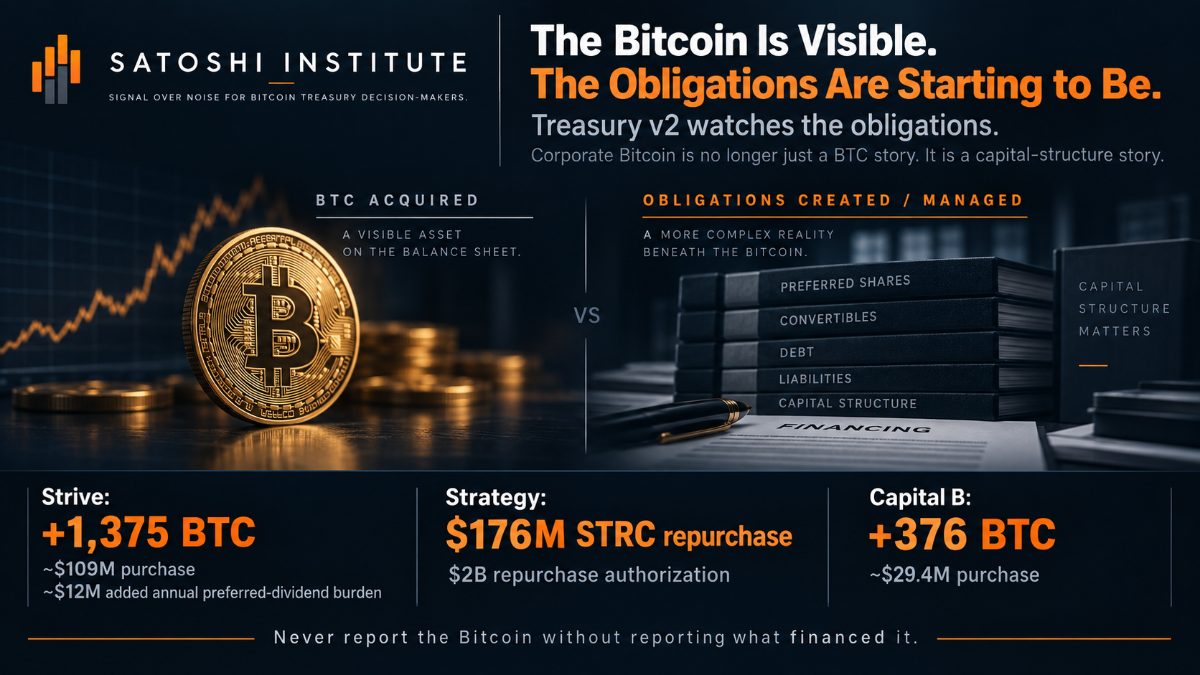
Strive reportedly issued nearly 1 million additional preferred shares in a single week, adding almost $12 million of annualized preferred-dividend obligations, while continuing to finance Bitcoin purchases.
Strategy, meanwhile, did something very different. Rather than adding Bitcoin during the week, it reportedly spent about $176 million repurchasing STRC preferred shares and expanded the authorized STRC repurchase program to $2 billion.
One company is using preferred capital to accelerate the Bitcoin side of the balance sheet.
The other is using capital to manage the preferred side.
That is not a contradiction.
It is what happens when the treasury becomes a financing system rather than a pile of coins.
The Day’s Signals
1. Strive adds Bitcoin, and another $12 million to the annual dividend tab
Strive’s recent acquisition remains impressive on the surface.
Approximately 1,375 BTC for roughly $109 million, taking holdings to about 24,531 BTC
But the more important Treasury v2 number may be elsewhere.
According to the reporting in today’s news set, Strive issued nearly one million new SATA preferred shares and added almost $12 million to its annualized preferred-dividend burden in one week.
That is the other side of the acquisition. The treasury did not simply gain Bitcoin. It also acquired another recurring obligation.
Governance signal
A Bitcoin purchase financed through preferred equity should be evaluated as a paired transaction:
BTC acquired versus new claims and recurring cash obligations created.
The Bitcoin appears immediately on the balance sheet. The dividend obligation keeps showing up.
2. Strategy spends $176 million reducing preferred exposure
Strategy reportedly skipped another Bitcoin purchase and instead deployed about $176 million to repurchase STRC preferred shares.
It also reportedly doubled the authorization for the STRC repurchase program to: $2 billion.
That is difficult to square with the simplest version of the Bitcoin treasury narrative:
Raise capital. Buy Bitcoin. Repeat forever.
But it makes considerably more sense if Strategy is viewed as a capital allocator operating a complex treasury system. At some point, issuing securities is only half the job. The securities themselves must be managed.
Governance signal
This is the maturation of the wrapper. Preferred securities can finance Bitcoin accumulation. They can also become a competing use of capital. The same instrument that expands the treasury today may need to be supported, refinanced or retired tomorrow.
3. “Never sell” meets corporate reality
One of the more revealing items in today’s news set reports Strategy CEO Phong Le describing “never sell” as essentially a marketing slogan rather than an immutable corporate rule.
That distinction matters.
“Never sell” works beautifully as conviction language. It works considerably less well as treasury policy.
A corporation has creditors, financing obligations, liquidity requirements, regulatory considerations and shareholders. No board should willingly bind itself to a capital-allocation decision regardless of future circumstances.
Governance signal
A slogan is not a disposition policy.
Treasury v2 needs explicit answers to questions such as:
- When may Bitcoin be sold?
- Who has authority?
- What liquidity event would justify it?
- What debt or preferred obligation takes precedence?
- What approval and documentation are required?
Institutional Bitcoin becomes stronger, not weaker, when those questions are answered before they are needed.
4. Capital B keeps accumulating
Capital B reportedly purchased another 376 BTC for approximately $29.4 million bringing total holdings to roughly 3,521 BTC.
The company has also recently attracted significant outside capital, including funding associated with Adam Back. The accumulation itself is straightforward. The more interesting issue remains the economics of the financing supporting it.
Current reporting also cites a year-to-date BTC Yield of 2.17%, equivalent to approximately 61.3 BTC of BTC Gain under that metric.
That is precisely the kind of number that needs context.
Governance signal
A treasury metric should tell boards what improved economically, not merely provide another growth statistic.
BTC Yield may be useful. But it should sit beside:
- share count,
- financing cost,
- preferred obligations,
- debt,
- cash reserves,
- and per-share Bitcoin exposure.
No single metric should be allowed to perform all the storytelling.
What This Actually Means
The most important development today is not another corporate Bitcoin purchase. It is that the liability side of Bitcoin treasury strategies is becoming increasingly visible.
Strive demonstrates one direction:
- Issue preferred securities.
- Create recurring obligations.
- Acquire more Bitcoin.
Strategy demonstrates another:
- Use capital to repurchase preferred securities rather than acquire more Bitcoin.
These are two stages of the same institutional evolution.
At first, the market asks: How much Bitcoin did you buy?
Later, it must ask: What did you issue to buy it?
Eventually, it asks: How much does that financing cost to maintain?
And finally: What happens when supporting the capital structure becomes more important than buying another Bitcoin?
That last question is where Treasury v2 begins.