
The Fed gave treasury companies time. Not absolution.
The Fed gave treasury companies time. Not absolution.
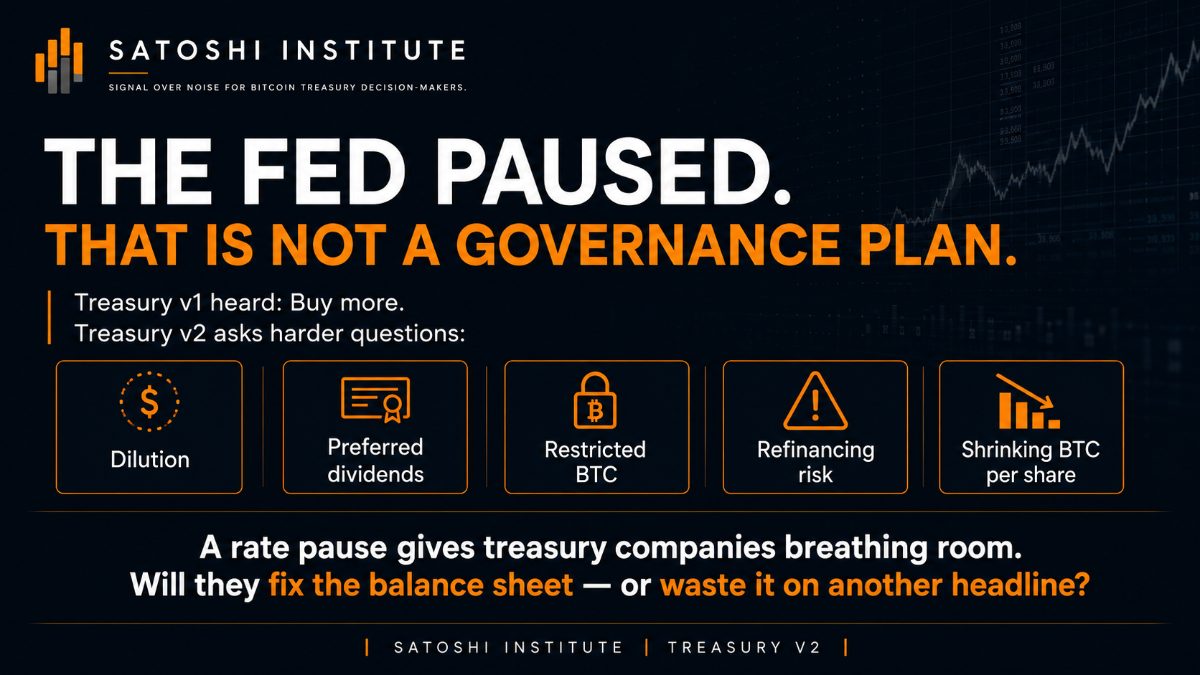
Daily Perspective
The Federal Reserve held its target rate at 3.50% to 3.75% for a fifth consecutive meeting. That removes the immediate threat of another increase and offers some relief to liquidity-sensitive assets, including Bitcoin and the public companies wrapped around it.
Naturally, the market will call the pause bullish.
Perhaps.
But a steady policy rate does not repair a treasury company that accumulates Bitcoin more slowly than it creates new claims against shareholders. It does not make liabilities disappear. It does not transform a discounted corporate wrapper into a bargain without first asking who else has a claim on the assets.
The Fed declined to tighten the vise.
Treasury boards still have to explain why their own hands are on the handle.
The Day’s Signals
Strategy pauses. Strive crosses 20,000 BTC.
Strategy has spent several weeks prioritizing its dollar reserve and capital structure rather than adding Bitcoin. Its STRC dividend rate is currently 12%, and the company has emphasized maintaining cash reserves to support preferred dividends and debt obligations.
Meanwhile, Strive has continued to accumulate. Its June filing showed 19,864 BTC, up from 13,628 BTC at the end of March, alongside a rapidly expanding mix of common and preferred shares.
Crossing 20,000 BTC makes an excellent headline.
The governance question is whether each effective common share owns more Bitcoin afterward.
A treasury can increase the stack while reducing each shareholder's economic exposure. There is a technical term for that.
It is not accretion.
Hyperscale’s Bitcoin is worth more than the simple market-cap comparison suggests. And less.
Hyperscale Data continues adding Bitcoin while operating an AI data center business. Its earlier filings also show that some Bitcoin has been classified as restricted, meaning the total holding figure does not automatically equal freely deployable liquidity.
This matters because investors frequently compare the market value of a company’s Bitcoin holdings to its equity market capitalization and conclude that the stock is obviously mispriced.
That comparison ignores:
- liabilities
- restricted assets
- subsidiary claims
- dilution
- operating cash needs
- execution risk in the underlying business
A company trading below the gross value of its Bitcoin may be undervalued.
It may also be telling investors that the wrapper has costs.
Debt reduction is becoming a competitive advantage
B Treasury Capital announced that it had repaid its interest-bearing debt and become debt-free.
That development will not generate the same excitement as purchasing another block of Bitcoin. It may be more important.
A debt-free treasury has fewer mandatory cash claims, less refinancing exposure, and greater freedom to wait through market stress. That flexibility becomes especially valuable when rates remain elevated even without an additional hike.
Treasury v1 celebrates the asset acquired.
Treasury v2 also counts the obligations removed.
The Fed’s pause helps. It does not mean easy money has returned.
The Federal Reserve’s statement said economic activity continued expanding at a solid pace, while uncertainty remained elevated. The Committee held rates in a 9–3 vote, showing that policy disagreement has widened even though the target range did not change.
This is supportive compared with an actual hike, but it should not be confused with easing.
Capital remains expensive.
Preferred dividends still have to be paid.
Debt still matures.
Equity issued today still dilutes tomorrow’s shareholders.
The policy pause reduces one source of pressure. It does not reopen every financing window.
What This Actually Means
The Fed’s decision gives Bitcoin treasury companies time.
What they do with that time will separate the durable companies from the enthusiastic ones.
A stable policy rate may support Bitcoin, equity markets, and financing conditions at the margin. It could make investors more willing to hold volatile or high-yield securities. It may reduce the immediate fear that funding costs will rise again.
But the companies themselves still have to create value.
Strive’s growth illustrates the central Treasury v2 problem. Total Bitcoin is an incomplete performance measure. The relevant question for common shareholders is whether Bitcoin per effective share increased after accounting for all common stock, preferred securities, convertibles, and other potentially dilutive claims.
The company can reach 20,000 BTC and still move backward economically for the investor who owned a share before the financing.
Hyperscale illustrates another incomplete comparison. Gross Bitcoin value does not equal net corporate value. Before calling the company discounted, investors need to know which Bitcoin is unrestricted, which liabilities sit ahead of common equity, what additional capital the data center business needs, and how many shares may ultimately divide the remaining value.
Debt-free firms provide the cleanest contrast.
Removing debt does not make the treasury exciting.
It makes it harder to kill.
That is the difference between a balance sheet designed for a rally and one designed to survive a cycle.
The Fed may have made the macro environment slightly less hostile.
Boards should resist treating that as permission to resume undisciplined accumulation. The correct response to improved conditions is not automatically to buy more Bitcoin. It is to rerun the capital-allocation analysis.
The next dollar still has several possible uses:
- acquire Bitcoin
- repay debt
- preserve liquidity
- repurchase discounted shares
- retire preferred obligations
- invest in the operating business
The rate decision changes the assumptions.
It does not choose the answer.